
 Add as a preferred source on Google
Written by The Skin Firm clinical content team · Reviewed by Dr. Karishma Singh, BHMS, FCHD (Founder, Skin & Aesthetic Specialist) · Reviewed on 25 November 2026
Quick answer
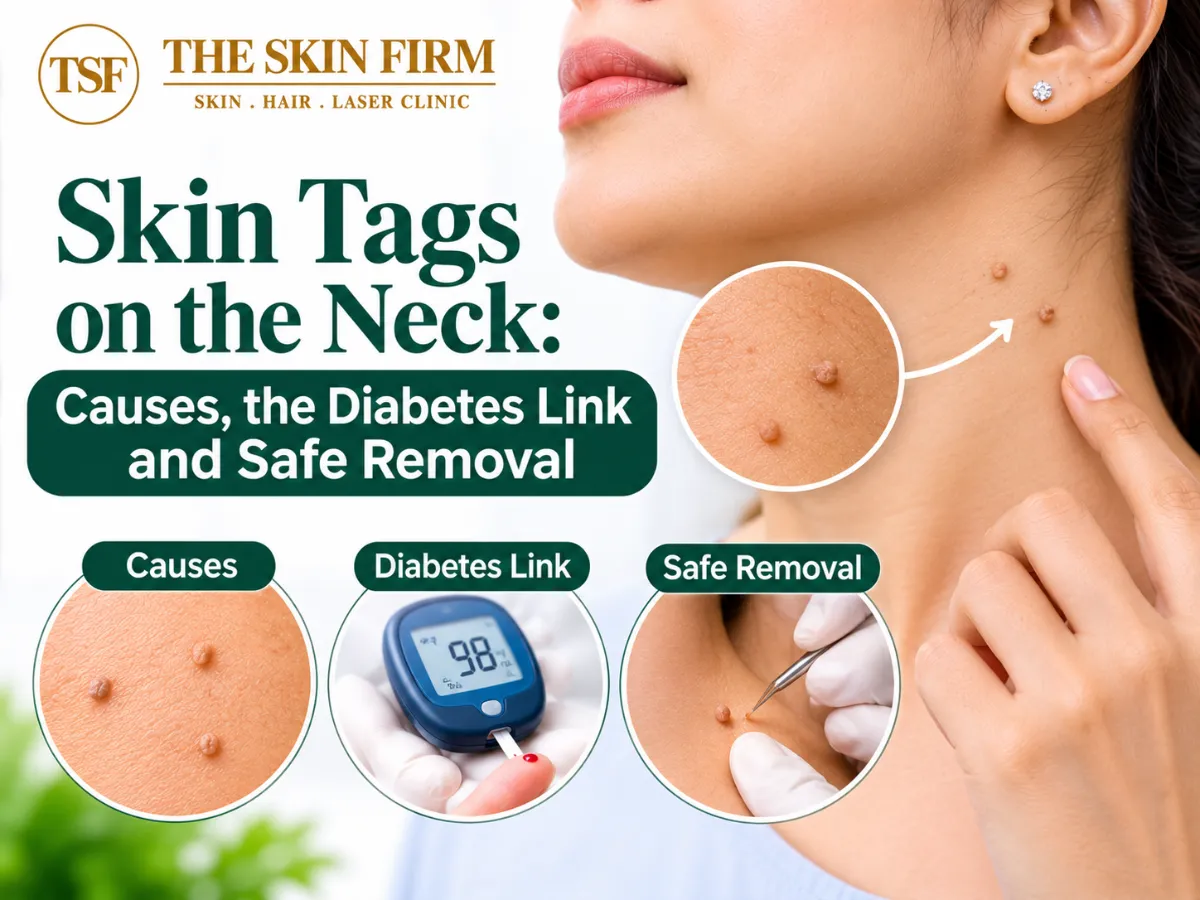
Skin tags are soft, harmless flaps of skin that grow where skin rubs, which is why the neck is so common. They are linked to friction, weight gain, type 2 diabetes, insulin resistance and pregnancy, and they become more common with age. Many skin tags on the neck can be a sign of insulin resistance, so a blood sugar check is worth discussing with a doctor. Don't cut, tie or burn them off at home; a doctor can remove them quickly with freezing, a fine surgical snip or electrosurgery.
What skin tags are
Skin tags (the medical name is acrochordons) are small, soft growths that hang from the skin on a thin stalk. DermNet, the New Zealand dermatology resource, describes them as common and harmless, skin-coloured or darker, and ranging from about 1 mm to 5 cm. They usually appear in skin folds: the neck, armpits, groin, eyelids and under the breasts.
They are not contagious, and they are not a form of cancer.
What causes skin tags on the neck
The exact cause isn't fully known, but several factors are linked:
- Friction. Collars, chains, necklaces and skin rubbing against skin. This is why the neck and armpits are the most common spots.
- Weight gain and obesity, which create more skin folds and more rubbing.
- Type 2 diabetes and insulin resistance. The NHS notes that severe insulin resistance is thought to encourage their growth.
- Pregnancy, because of hormone and growth-factor changes. Some tags shrink after delivery, but many stay.
- Age. They become more common from middle age onwards.
- A family tendency, as skin tags often run in families.
- HPV, listed by DermNet as a possible factor, though it is not the main cause.
There is no evidence that perfume, retinol or sunscreen causes skin tags.
Are skin tags on the neck a sign of diabetes?
Not always, but they can be a clue. The Merck Manual notes that multiple skin tags may be associated with insulin resistance, and that screening people with many skin tags for insulin resistance is sometimes recommended.
A blood sugar check is worth discussing with your doctor if you have:
- many skin tags, or new ones appearing quickly
- dark, velvety skin on the neck or in the armpits (acanthosis nigricans)
- weight gain around the waist
- a family history of diabetes, or PCOS
Dark, thick skin along with skin tags is a strong pointer. Our guide to dark neck and acanthosis nigricans explains the link.
Skin tag, wart, mole or DPN?
Several growths on the neck look alike:
- Skin tag: What it looks like: Soft, smooth flap on a thin stalk; skin-coloured or brown; Key difference: Moves easily; doesn't spread
- Wart: What it looks like: Rough or flat bump; may appear in lines; Key difference: Caused by a virus; can spread
- Mole: What it looks like: Flat or raised brown spot, usually round; Key difference: Should be checked if it changes
- DPN (dermatosis papulosa nigra): What it looks like: Small, dark, flat-topped bumps on the face and neck; Key difference: Common in brown skin; runs in families
- Seborrhoeic keratosis: What it looks like: Waxy, "stuck-on" brown patch; Key difference: Usually after 40; harmless
Read more about warts in warts on the face and why they spread, and about dark spots on the face and neck in our guide to DPN. If a growth is changing, a doctor should look at it.
Why you shouldn't remove skin tags at home
The NHS advises against removing your own skin tags because of the risk of infection, bleeding and scarring. Common home methods each have problems:
- Tying with thread or dental floss. Can be painful, bleed and get infected, and may leave part of the stalk behind.
- Cutting with scissors or nail clippers. Even small tags can bleed more than expected, and the wound can scar or darken.
- Apple cider vinegar, tea tree oil or garlic. These can cause chemical burns and dark patches on the surrounding skin, especially on brown skin.
- Skin tag removal creams, patches and "freeze" pens. Quality and ingredients vary, and they can burn the skin around the tag.
Skin tags near the eyes need particular care and should only be removed by a doctor.
How doctors remove skin tags
Skin tags only need removing if they bother you, catch on clothing or jewellery, or you don't like how they look. DermNet and the Merck Manual describe these methods:
- Snip excision: the tag is numbed and cut off at the base with fine surgical scissors.
- Cryotherapy: freezing with liquid nitrogen, so the tag falls off over a week or two.
- Electrosurgery (radiofrequency or cautery): a fine heated tip seals and removes the tag; useful for many small tags in one sitting.
- Laser: some clinics use lasers for very small tags.
The NHS notes that once a skin tag is removed it usually doesn't return, but new ones can form elsewhere. It also notes that removal can leave a small scar or darkening, especially on brown or black skin, which is usually temporary.
Can you prevent skin tags?
You can't always prevent them, but these help:
- keep blood sugar and weight in a healthy range
- reduce friction: softer collars and lighter chains
- keep skin folds clean and dry
- get many or fast-appearing tags checked
When to see a doctor
The NHS advises seeing a doctor if a skin tag:
- gets bigger
- becomes painful
- bleeds
- is one of many new tags appearing quickly
Also see a doctor if a growth changes colour or shape, or you're not sure it is a skin tag.
Skin tag removal at The Skin Firm, Pune
At The Skin Firm, the doctor first confirms that a growth is a skin tag and not a wart, mole or DPN, then removes it with a method suited to its size and your skin. If you have many skin tags, the doctor may suggest a blood sugar test. You can also read whether mole removal is safe and how mole removal differs from wart removal.
Learn more about mole and skin tag removal in Pune or book a consultation.
References
This article is for general information and isn't a substitute for a medical consultation. Editorial note: drafted with AI assistance and medically reviewed before publication.