 Add as a preferred source on Google
Written by The Skin Firm clinical content team · Reviewed by Dr. Karishma Singh, BHMS, FCHD (Founder, Skin & Aesthetic Specialist) · Reviewed on 20 November 2026
Quick answer
Warts on the face are caused by human papillomavirus (HPV) entering tiny breaks in the skin. They spread to new spots through touching, picking and especially shaving, which carries the virus along the beard or jaw line. They often seem to "come back" because treatment removes the visible wart but not the virus, and new warts can take up to 12 months to appear after you caught it. Facial warts should be treated by a doctor, not with pharmacy wart paints, which are meant for hands and feet.
What causes warts on the face
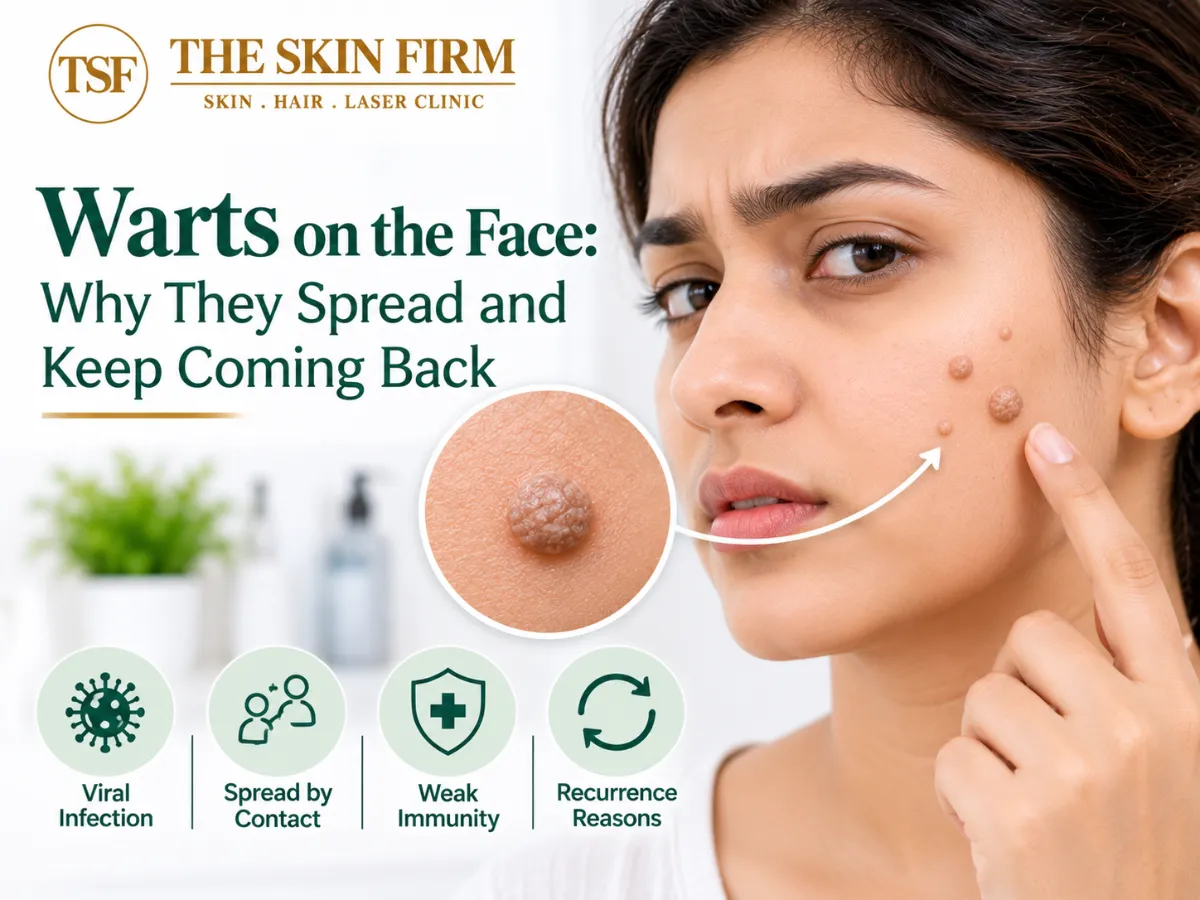
Warts are small skin growths caused by human papillomavirus (HPV). There are more than 150 types of HPV, and different types prefer different parts of the body. DermNet notes that flat warts, the type most common on the face, are mainly caused by HPV types 3 and 10.
The virus needs a way in. The American Academy of Dermatology (AAD) explains that HPV enters through a cut, scratch or small break in the skin. On the face, that break is often a shaving nick, a scratched pimple, a threading or waxing mark, or skin cracked by eczema.
These are the warts most often seen on the face and neck:
- Flat warts: What it looks like: Small, smooth, slightly raised bumps, skin-coloured to light brown; often in groups or lines; Common spots: Forehead, cheeks, beard area, chin
- Filiform warts: What it looks like: Thin, thread-like or finger-like growths that stick out from the skin; Common spots: Around the eyes, nose, lips, neck
- Common warts: What it looks like: Rough, firm, dome-shaped bumps; Common spots: Less common on the face; more on hands
Not every bump on the face is a wart. Skin tags, moles, milia and the small dark spots called DPN can look similar. Our guides to mole removal vs wart removal and DPN black spots on the face explain the differences.
Why facial warts spread
Facial warts rarely stay as one. DermNet describes this as autoinoculation, meaning you spread the virus to new spots on your own skin. The most common ways it happens:
- Shaving. A razor drags the virus along the skin and creates tiny cuts where it can settle. This is why flat warts often appear in a line along the beard or jaw.
- Picking and scratching. Touching a wart and then another part of the face moves the virus.
- Threading, waxing and plucking. Each one causes small breaks in the skin.
- Sharing towels, razors or face cloths with someone who has warts.
The AAD adds that people who bite their nails, have eczema, have a weakened immune system or are pregnant are more likely to get warts.
Why warts keep coming back
This is the most common frustration with facial warts, and there are three reasons for it.
- 1. Treatment removes the wart, not the virus. DermNet notes that no treatment kills HPV. Freezing, burning or laser removes the visible growth, and the immune system then has to finish the job.
- 2. New warts were already incubating. DermNet notes that a wart can take up to 12 months to appear after the virus enters the skin. A "new" wart after treatment may have been picked up months earlier.
- 3. The immune system takes time. In children, DermNet reports that about half of warts clear without treatment within six months and 90% within two years. Warts last longer in adults, and recurrence is more likely in smokers and people with a weakened immune system.
So a wart that returns does not mean the treatment failed. It usually means more sessions, more time, or stopping the habit that keeps spreading the virus.
Are warts on the face contagious?
Yes, mildly. Warts spread by skin contact and through shared items such as towels and razors. Most adults are exposed to HPV without getting warts, so catching them depends on your immune response as well as contact. Until your warts clear:
- wash your hands after touching them
- use your own towel and razor
- avoid picking or scratching them
- cover a wart if it is likely to be rubbed or knocked
Warts on the face after shaving
Men with flat warts in the beard area should be careful with razors until the warts clear. The NHS advises not to cut a wart when shaving. Helpful steps:
- switch to an electric trimmer that leaves a little stubble, so the blade doesn't touch the skin
- if you must use a razor, use a new blade each time and never share it
- shave around warts, not over them
- don't use the same razor on the rest of the face after passing it over a wart
Women who get warts after threading or facial waxing should pause hair removal on that area until a doctor has checked the skin.
What not to put on facial warts
Many home remedies are risky on facial skin, which is thinner than the skin on hands and feet.
- Pharmacy wart paints, gels and freezing kits. The NHS advises against using them on the face, and the AAD notes salicylic acid wart products should not be used on the face. They are made for thick skin and can burn or scar the face.
- Apple cider vinegar, garlic, lemon or toothpaste. These can cause chemical burns and dark marks, especially on brown skin.
- Tying thread or hair around a wart, or cutting it off. This risks bleeding, infection, scarring and spreading the virus.
- Unknown creams or "wart removal" ointments from social media.
A Cochrane review of wart treatments found that salicylic acid works better than placebo for warts on the hands and feet. That evidence is for thick skin, not the face.
How doctors treat warts on the face
The AAD recommends that facial warts be treated by a specialist. A doctor will choose an option based on the wart type, how many there are, and your skin tone.
- Cryotherapy (freezing). The AAD notes the skin usually heals in four to seven days, and treatment is repeated every two to four weeks. DermNet reports about 70% of warts clear after three to four months of regular treatment. In brown skin, freezing can leave light or dark marks, so the doctor will adjust it.
- Electrosurgery (radiofrequency). Useful for filiform warts. DermNet notes about 20% recur after this method, and it can leave a small scar.
- Laser. Used for stubborn warts. The AAD notes the area may be sore for up to two weeks.
- Prescription creams. For many small flat warts, a doctor may prescribe a cream to irritate them gradually or help the immune system respond.
More than one session is common, and a doctor will usually review new warts at each visit so they are treated early.
When to see a doctor
See a doctor if:
- you have any wart on the face (the NHS advises a doctor's review for facial warts)
- the growth bleeds, changes shape or colour, or grows quickly
- you are not sure it is a wart
- warts keep spreading despite home care
- you have a weakened immune system or diabetes
Wart removal at The Skin Firm, Pune
At The Skin Firm, the doctor first confirms whether a growth is a wart, a skin tag, a mole or DPN. Facial warts are then treated with methods suited to facial skin and brown skin tones, with a plan to reduce the chance of new warts appearing. If you have skin tags or moles as well, the doctor may suggest mole and skin tag removal in the same plan. You can also read whether mole removal is safe.
Learn more about wart removal treatment in Pune or book a consultation.
References
- DermNet. Viral warts.
- American Academy of Dermatology. Warts: diagnosis and treatment.
- American Academy of Dermatology. Warts: who gets and causes.
- NHS. Warts and verrucas.
- Kwok CS, Gibbs S, Bennett C, Holland R, Abbott R. Topical treatments for cutaneous warts. Cochrane Database of Systematic Reviews. 2012.
This article is for general information and isn't a substitute for a medical consultation. Editorial note: drafted with AI assistance and medically reviewed before publication.