
 Add as a preferred source on Google
Written by The Skin Firm clinical content team · Medically reviewed by Dr. Monica C., MD (Dermatology, Venereology & Leprosy) · Reviewed on 16 October 2026
Quick answer
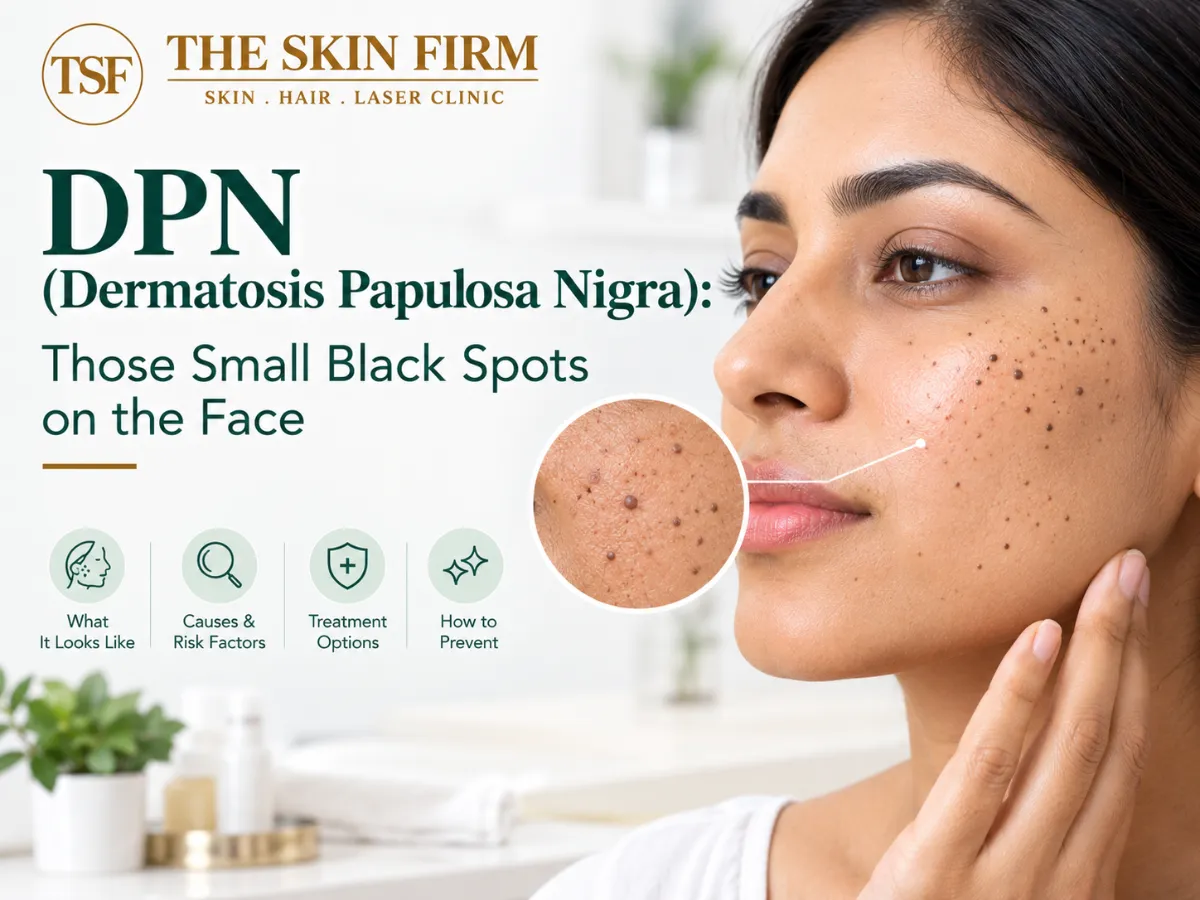
DPN (dermatosis papulosa nigra) is a common, harmless skin condition that causes small, dark brown or black raised spots, usually on the cheeks, around the eyes, on the forehead and on the neck. It's more common in Indian and other darker skin types, runs in families and increases with age. DPN doesn't turn into cancer. Removal is optional and cosmetic, usually done with electrocautery (radiofrequency) or laser by a doctor.
Many people describe DPN as "small black moles" or "black dots that keep increasing on my face". Because they look like moles, people often worry about them or try to remove them at home. This guide explains what DPN is, how a doctor tells it apart from moles and other growths, and what removal involves. If you have other skin growths too, see our page on mole and skin tag removal in Pune.
What is DPN?
Dermatosis papulosa nigra is a benign (non-cancerous) growth of the outer layer of the skin. Doctors consider it a variant of seborrhoeic keratosis, the common "age spots" or "wisdom warts" that appear on many adults.
Typical features:
- Small, 1–5 mm, smooth, dark brown to black bumps
- Slightly raised or dome-shaped, sometimes on a tiny stalk
- Usually not painful or itchy
- Found on the cheekbones, under and beside the eyes, forehead, neck and upper chest
- Start in adolescence or early adulthood and slowly increase in number and size over the years
DPN is very common in people of South Asian, African and East Asian descent. It often runs in families: if your parents or grandparents have many small dark spots on their cheeks, you're more likely to develop them too. Women are affected somewhat more often than men.
Is DPN dangerous?
No. DPN is benign and doesn't become skin cancer. It isn't contagious and isn't caused by poor hygiene or diet.
However, not every dark spot on the face is DPN. Any spot that looks different from the others, or is changing, should be checked. That's why a doctor's examination comes before any cosmetic removal.
DPN vs moles, skin tags and other spots
- DPN: What it looks like: Many small, dark, smooth bumps on cheeks, around eyes and neck; Key difference: Appear in clusters; grow slowly with age; family history common
- Mole (melanocytic naevus): What it looks like: Flat or raised brown spot, can have hair; Key difference: Usually fewer; each mole is a collection of pigment cells
- Seborrhoeic keratosis: What it looks like: Larger, waxy, "stuck-on" brown spots, often on trunk; Key difference: DPN is a small, facial version of this
- Skin tag: What it looks like: Soft, skin-coloured or brown flap on a stalk; Key difference: Common on the neck, underarms and eyelids; soft and floppy
- Wart: What it looks like: Rough, grainy bump; may have tiny dots; Key difference: Caused by a virus; can spread
- Melanoma (rare, needs urgent care): What it looks like: Spot with irregular edges, several colours, growth or bleeding; Key difference: A spot that changes or looks unlike your others
If you're wondering about moles in particular, our guide Is mole removal safe? explains how moles are assessed.
Warning signs that need prompt attention
Use the ABCDE guide for any dark spot:
- Asymmetry: one half doesn't match the other
- Border: ragged, notched or blurred edges
- Colour: several shades, or patches of red, white or blue
- Diameter: larger than about 6 mm, or bigger than your other spots
- Evolving: changing in size, shape, colour, or starting to itch or bleed
A spot with any of these features should be examined by a doctor before any treatment. DPN rarely shows them, which is one way doctors tell the difference.
Why do DPN spots increase over time?
The exact cause isn't fully understood, but these factors play a role:
- Genetics. Family history is the strongest factor
- Age. New spots appear and existing ones enlarge slowly with age
- Skin type. More melanin-rich skin is more prone
- Hormonal changes. Some people notice more spots after pregnancy
- Sun exposure may contribute, as DPN is found mainly on sun-exposed areas
There is no reliable way to prevent DPN. Daily sunscreen is good for skin health in general, but it won't stop DPN from developing in people who are genetically prone.
Can creams remove DPN?
No cream has been shown to reliably remove DPN spots. They're raised growths of skin cells, so they need a physical procedure to flatten or remove them. Pigmentation creams may lighten the skin around the spots but won't remove the spots themselves.
Don't try to remove DPN at home
Home methods such as tying thread around spots, applying garlic, apple cider vinegar or acids, cutting them or using "mole removal pens" carry real risks:
- Burns, infection and bleeding
- Scarring and dark or light marks, which are more likely in Indian skin
- Treating a spot that isn't DPN without a diagnosis
The face is particularly unforgiving, and the area around the eyes is delicate.
How DPN is removed in the clinic
Removal is a cosmetic choice. If the spots don't bother you, there's no medical need to remove them. If you do want them removed, a doctor will first examine the spots, then choose a method based on their size, number and location. The doctor who performs the procedure is confirmed at the consultation.
- Electrocautery or radiofrequency: How it works: A fine probe uses controlled energy to flatten or remove each spot; Notes: Commonly used; precise for small spots
- Laser: How it works: Laser energy targets the spots (Nd:YAG or CO2, depending on the lesion); Notes: Useful for clusters; settings chosen for skin type. See CO2 laser
- Curettage or snip removal: How it works: Spot gently scraped or snipped off after numbing; Notes: Suits larger or stalked spots
- Cryotherapy (freezing): How it works: Liquid nitrogen freezes the spot; Notes: Used less often in darker skin due to risk of light patches
Studies of electrodesiccation and plasma-based devices for DPN, including Indian research, report good cosmetic results in many patients, with mild, temporary side effects. Numbing cream is usually applied first.
What to expect after removal
- Each treated spot forms a tiny scab or crust within a day
- The crusts fall off on their own in about 5–10 days. Don't pick them
- The skin underneath may look pink or slightly darker or lighter for a few weeks before it blends in
- Many people return to work the same day; you may want to plan around important events because of the small crusts
Possible side effects include temporary redness, darkening (post-inflammatory hyperpigmentation), light patches and, rarely, small scars. Treating cautiously and following aftercare lowers these risks.
New spots can appear over time, because the tendency to form DPN remains. Many people choose to have new spots removed every year or two.
Aftercare
- 1. Keep the area clean and dry for the first day
- 2. Apply the ointment your doctor recommends until the crusts fall off
- 3. Don't pick, scrub or apply makeup on the crusts
- 4. Use sunscreen daily for at least a month to prevent dark marks
- 5. Avoid facials, peels and strong actives until the skin has fully healed
How many sessions are needed?
If you have a few spots, one session is often enough. If you have dozens, your doctor may treat them in batches over two or three sessions, which lets the skin heal and lets you see how it responds. The number of spots, their size and their location all affect the plan, which a doctor can estimate after examining you.
Planning DPN removal around events and seasons
Because the treated spots form small crusts for about a week, and the skin may stay slightly darker for a few weeks, timing matters:
- Before a wedding or big event: plan removal at least 6–8 weeks ahead, so any temporary marks have time to settle
- Season: many people prefer the cooler months, when sun exposure and sweating are lower. Treatment is possible year-round with good sun protection
- Travel: avoid beach holidays or long outdoor trips for a few weeks after treatment
- Work: most people go back to work the same day. If you'd rather not have visible crusts, a Friday or weekend appointment helps
DPN around the eyes, in the beard area and on the neck
Around the eyes. DPN often clusters on the upper cheeks and under the eyes. These spots can be treated, but the skin here is thin, so a doctor uses lower energy settings and protects the eyes during treatment.
Beard area (men). Spots in the beard area get nicked during shaving and may bleed or become irritated. After removal, avoid shaving the treated area until the crusts have fallen off, or use a trimmer around them.
Neck. DPN on the neck can rub against collars and chains. Neck spots sometimes appear alongside skin tags, and both can be treated in the same session.
Myths about DPN
"These are moles that will turn into cancer." DPN isn't a mole and doesn't become cancer. The concern is only that a different, changing spot might be mistaken for DPN, which is why an examination matters.
"Removing one will make more grow." Removing a spot doesn't trigger new ones. New spots appear because of age and genetics, whether or not you've had treatment.
"Pigmentation creams will fade them." DPN spots are raised growths. Creams don't remove them, and strong bleaching products can damage the surrounding skin.
"DPN comes from oily food or poor skincare." There's no evidence linking DPN to diet or hygiene. It's mostly genetic.
"Treatment always leaves scars." With appropriate technique and aftercare, most spots heal without visible scars. Temporary colour change is more common than scarring.
When to see a doctor
- You're unsure whether a spot is DPN, a mole or something else
- A spot is changing, bleeding, itching or looks different from the others
- Spots are increasing quickly
- You'd like them removed safely
You can book a consultation at The Skin Firm, a skin, hair and laser clinic at NIBM Road, Pune, to have your spots examined and discuss removal options.
References
- Dermatosis papulosa nigra — DermNet
- Ionized plasma jet therapy in removal of dermatosis papulosa nigra — Indian Dermatology Online Journal, 2024
- Treatment outcomes for dermatosis papulosa nigra using a low-intensity electrodesiccation device — Journal of Cosmetic Dermatology, 2024
This article is for general information and isn't a substitute for a medical consultation. Editorial note: drafted with AI assistance and medically reviewed before publication.