 Add as a preferred source on Google
Written by The Skin Firm clinical content team · Medically reviewed by Dr. Monica C., MD (Dermatology, Venereology & Leprosy) · Reviewed on 16 October 2026
Quick answer
Fungal acne isn't true acne. It's an infection of the hair follicles by Malassezia, a yeast that normally lives on skin. It shows up as small, itchy, same-sized bumps on the forehead, chest, back or shoulders, often after sweating or humid weather. Because it's caused by yeast, regular acne treatments and antibiotics usually don't clear it, and antifungal treatment does.
Many people in Pune notice a crop of tiny bumps on the forehead or upper back after the monsoon, or after starting a new gym routine. They try every acne face wash and spot cream, and nothing changes. If that sounds familiar, the bumps may not be acne at all. This guide explains how to tell fungal acne from regular acne, why it happens and how it's treated. For other types of breakouts, see our page on acne treatment in Pune.
What is fungal acne?
The medical name is Malassezia folliculitis (also called Pityrosporum folliculitis). Malassezia is a yeast found on almost everyone's skin, especially in oily areas. Usually it causes no trouble. When conditions favour it (heat, sweat, oil and trapped moisture) it overgrows inside the hair follicles. The follicles become inflamed and form small, itchy bumps that look a lot like pimples.
Regular acne (acne vulgaris) is different. It starts with clogged pores (blackheads and whiteheads), and the bacterium Cutibacterium acnes plays a role along with oil and hormones. That is why the two respond to different treatments.
The two can also happen together. A 2022 study of patients diagnosed with acne found that a meaningful share also had Malassezia folliculitis, which helps explain why some "stubborn acne" never clears with standard treatment.
Fungal acne vs regular acne: how to tell them apart
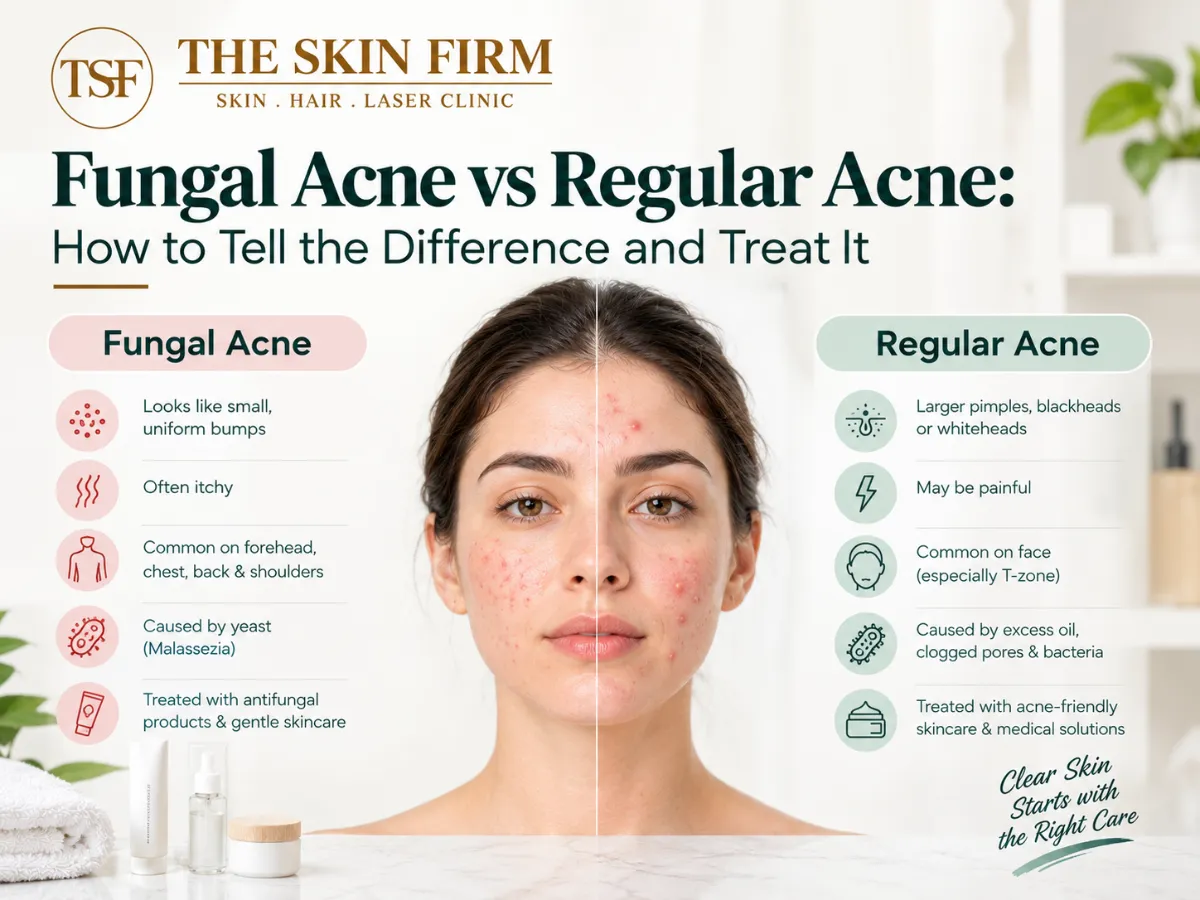
- Itch: Fungal acne (Malassezia folliculitis): Often itchy, sometimes very; Regular acne: Usually not itchy; may be tender
- Size and shape: Fungal acne (Malassezia folliculitis): Small (1–2 mm), uniform bumps and pustules; Regular acne: Mixed sizes: blackheads, whiteheads, red bumps, sometimes cysts
- Blackheads: Fungal acne (Malassezia folliculitis): Absent; Regular acne: Common
- Where: Fungal acne (Malassezia folliculitis): Forehead, hairline, chest, upper back, shoulders, upper arms; Regular acne: Face (cheeks, chin, nose, forehead), sometimes chest and back
- Pattern: Fungal acne (Malassezia folliculitis): Appears in crops, often all at once; Regular acne: Comes and goes, often linked to periods or stress
- Triggers: Fungal acne (Malassezia folliculitis): Heat, humidity, sweat, tight clothing, antibiotics, steroid creams; Regular acne: Hormones, oily skin, genetics, some cosmetics
- Response to acne treatment: Fungal acne (Malassezia folliculitis): Little or none; may get worse on antibiotics; Regular acne: Usually improves over weeks
This table is a guide, not a diagnosis. Some other conditions, such as bacterial folliculitis, heat rash and steroid-induced acne, can look similar. An examination is the only way to be sure.
Why does fungal acne flare in humid weather and after workouts?
Malassezia feeds on skin oils and thrives in warm, moist places. Several everyday situations tip the balance in its favour:
- Humid weather. Pune's monsoon and post-monsoon weeks keep the skin damp for long periods.
- Sweat that stays on the skin. Sitting in gym clothes, long commutes in helmets, or tight synthetic tops trap sweat against the follicles.
- Heavy, oily products. Thick creams, some hair oils along the hairline and pomades can feed the yeast.
- Antibiotics. Oral antibiotics, often prescribed for acne, reduce the bacteria that usually keep yeast in check.
- Steroid creams. Over-the-counter creams that contain steroids (sometimes sold as "fairness" or "rash" creams) can suppress the skin's local defences and encourage fungal growth.
- Lowered immunity. Diabetes, steroid tablets or other medical conditions can make it more likely.
Our post on gym and fitness skin problems covers sweat-related breakouts on the body in more detail.
Common mistakes that make it worse
Repeated antibiotic courses. If bumps don't improve after one course of antibiotics, taking another can make fungal acne worse. Ask your doctor whether a fungal cause has been considered.
Using steroid creams. They may calm redness for a few days, then the bumps return more strongly. Long-term use also thins the skin. Never use a steroid cream on the face unless a doctor has prescribed it for a specific reason.
Scrubbing hard. Harsh scrubs irritate inflamed follicles and don't remove yeast from inside them.
Layering heavy moisturisers. Rich, occlusive products can feed the yeast. Lighter, non-comedogenic textures are usually better.
Stopping treatment too early. Fungal acne often improves within a couple of weeks of the right treatment, but stopping as soon as it looks better increases the chance of it coming back.
How a doctor confirms fungal acne
Most of the time a doctor can recognise fungal acne from how it looks and where it is. When the picture isn't clear, simple tests can help:
- Dermoscopy: a magnified look at the bumps
- KOH mount: a gentle scraping from a bump examined under a microscope for yeast
- Response to treatment: sometimes a short antifungal course is used to confirm the diagnosis
The doctor will also ask about recent antibiotics, steroid creams, your skincare and your exercise routine, because these often explain why it started.
How fungal acne is treated
Treatment depends on how widespread it is and how long you've had it. Your doctor will choose what suits you, but the main options are:
Topical antifungals. Antifungal creams, or an antifungal shampoo used as a short-contact body or face wash, are often the first step for mild cases. Your doctor will tell you how long to leave it on and how often to use it.
Oral antifungal medicines. For widespread or stubborn cases, a short course of antifungal tablets may be prescribed. These are prescription medicines that need a doctor's assessment, because they can interact with other medicines and aren't suitable for everyone.
Treating regular acne too, if present. If you have both conditions, your doctor may combine antifungal treatment with suitable acne treatment.
Maintenance. Fungal acne tends to come back, especially in humid months. Many people are advised to keep using an antifungal wash once or twice a week as prevention.
In-clinic procedures aren't usually needed for fungal acne itself. If dark marks remain after the bumps settle, they generally fade with time and sun protection, and your doctor can advise on options such as gentle chemical peels once the skin is calm.
A skincare routine for fungal-acne-prone skin
Morning
- 1. Gentle, non-comedogenic cleanser
- 2. Light, oil-free moisturiser (a gel texture suits most people)
- 3. Broad-spectrum sunscreen with a lightweight, non-greasy texture
Evening
- 1. Cleanser (or your prescribed antifungal wash on treatment days)
- 2. Any treatment your doctor has prescribed
- 3. Light moisturiser if your skin feels dry
Habits that help
- Shower and change out of sweaty clothes soon after exercise
- Choose loose, breathable cotton for workouts and sleep
- Wash pillowcases, caps and helmet liners often
- Keep hair oils off the forehead and hairline, or wash them off after a few hours
- Patch-test new products one at a time
Ingredient lists for "fungal acne safe" products circulate widely online. They can be a useful starting point, but they aren't a substitute for diagnosis, and a product that suits one person may not suit another.
Other conditions that look like fungal acne
Several skin problems produce small bumps on the face and upper body. Knowing them helps explain why a doctor's examination matters.
- Bacterial folliculitis: Pustules around hairs, often tender rather than itchy; may follow shaving, waxing or hot tubs
- Heat rash (miliaria): Tiny clear or red spots in sweaty areas that appear quickly in heat and fade within days of cooling down
- Steroid-induced acne: Uniform bumps that appear after using steroid creams or tablets; can look almost identical to fungal acne
- Closed comedones: Skin-coloured "bumpy texture" on the forehead that isn't itchy and doesn't come in sudden crops
- Keratosis pilaris: Rough, dry bumps on the upper arms and thighs, not usually on the face; worse in dry weather
Sometimes more than one of these is present at once. Treating the wrong one is the most common reason bumps don't improve.
Fungal acne in Indian skin and Pune's climate
India's climate creates ideal conditions for Malassezia for much of the year. In Pune, the long monsoon and the humid weeks that follow keep skin damp, and many people commute on two-wheelers in helmets that trap sweat along the forehead. Office workers who move between air-conditioned rooms and humid streets often sweat and dry repeatedly through the day.
Indian skin also tends to develop dark marks (post-inflammatory hyperpigmentation) after any inflammation. With fungal acne, the bumps themselves usually settle well with treatment, but the brown marks they leave can take weeks or months to fade. Early, correct treatment means less inflammation and fewer marks. Picking or squeezing the bumps prolongs both.
Hair oiling, a common habit, deserves a mention. Oil left on the scalp overnight often drifts onto the forehead and hairline, exactly where fungal acne tends to appear. You don't need to stop oiling, but washing it out the next morning, or keeping it to the scalp, can help.
Preventing fungal acne from coming back every monsoon
Because Malassezia is a normal part of the skin, the aim is to keep it in balance rather than remove it completely. People who get fungal acne every year often do well with a simple seasonal plan:
- 1. Start prevention early. Before the humid months begin, ask your doctor whether a weekly antifungal wash makes sense for you.
- 2. Keep sweat short-lived. Shower or at least rinse after workouts and long commutes.
- 3. Check your products. Switch to lighter, oil-free moisturisers and sunscreens in humid months.
- 4. Watch medicines. If you need antibiotics or steroid tablets for any reason, mention your history of fungal acne to the prescribing doctor.
- 5. Act on the first crop. Treating a few itchy bumps early is easier than treating a widespread flare.
If flares keep returning despite these steps, your doctor may look for factors such as uncontrolled blood sugar or a medicine that affects immunity.
When to see a doctor
Book an appointment if:
- Bumps haven't improved after 4–6 weeks of regular acne care
- The bumps are itchy and spreading on the chest or back
- Acne got worse after a course of antibiotics or a steroid cream
- Breakouts keep returning every humid season
- You have diabetes or take medicines that lower immunity
If you want a doctor to check whether your breakouts are fungal, bacterial or both, you can book a consultation at The Skin Firm, a skin, hair and laser clinic at NIBM Road, Pune. To understand other acne types, read acne vs hormonal acne.
References
- Malassezia (pityrosporum) folliculitis — DermNet
- Fungal acne (Malassezia folliculitis) — Cleveland Clinic
- Malassezia folliculitis: an underdiagnosed mimicker of acneiform eruptions — Journal of Fungi, 2025
- Prevalence and clinical characterisation of Malassezia folliculitis in patients clinically diagnosed with acne vulgaris — Clinical, Cosmetic and Investigational Dermatology, 2022
This article is for general information and isn't a substitute for a medical consultation. Editorial note: drafted with AI assistance and medically reviewed before publication.