 Add as a preferred source on Google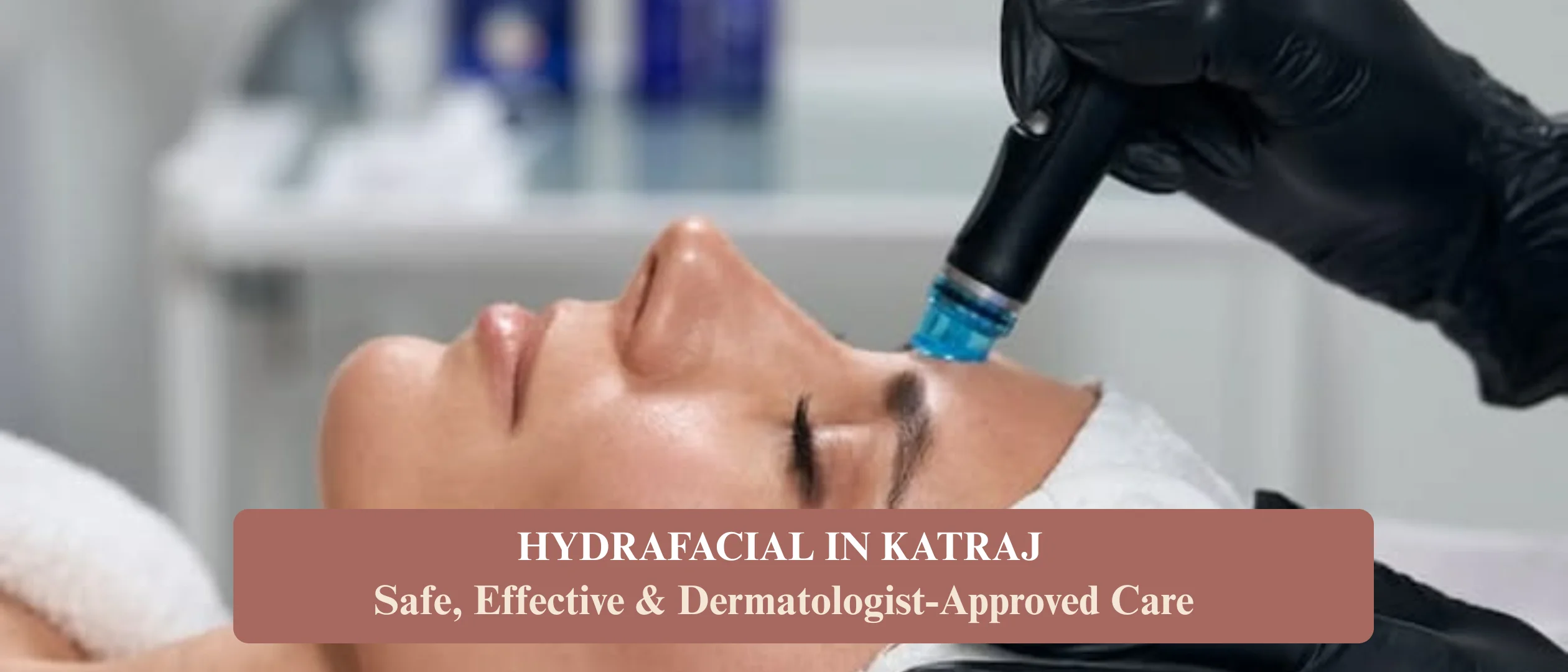
Most patients who come to us asking about HydraFacial are not in any kind of crisis. The skin is not badly broken out. Nothing dramatic has happened. It just looks duller than it used to, feels congested no matter what products are being used, and has reached a point where the usual routine simply is not doing much anymore. That combination is probably the most common thing we hear from patients coming in from Katraj.
It is a frustrating place to be, because the problem is real but hard to name.
A HydraFacial tends to be a useful starting point in that situation — not because it resolves everything, but because skin that has reached that state usually needs a proper reset before anything else can actually work on it.
What Is a HydraFacial?
A medical-grade skin treatment that cleans, exfoliates, extracts, and hydrates the skin all within one session. It uses a vortex-tip device that works in two directions simultaneously — pulling congestion out of the pore while pushing serums into it. That dual action is what distinguishes it from most other treatments, which tend to handle one part of the problem or the other, not both at once.
The comparison with a regular facial is worth making here. A standard facial applies product onto skin that has not actually been cleared first. The serums and moisturisers are sitting on top of whatever debris is still inside the pore. HydraFacial reverses that sequence — the extraction happens first, and the infusion follows immediately into skin that is now open and ready to receive it. The absorption difference is not minor.
Sessions are 30 to 45 minutes. No needles, no anaesthesia. Patients go about their day immediately after.
What Skin Concerns Does HydraFacial Treat?
More than one, which is genuinely part of what makes it worth considering.
Congestion responds well — particularly the persistent kind around the nose and chin that does not clear with home cleansing regardless of what products are tried. Dehydration improves because the hydration is going into the skin, not being layered on top of it. Texture, early pigmentation from sun exposure, and general dullness all tend to shift after a session or two.
Pigmentation specifically takes time. One session will not resolve it meaningfully. That is worth stating clearly rather than allowing patients to arrive with expectations the treatment cannot meet in a single sitting.
What it is not suited for: deep acne scarring, active inflamed breakouts, significant laxity. If that is what a patient is dealing with, we will say so and suggest something that actually addresses it.
What Does the HydraFacial Procedure Involve?
Five steps.
Cleansing and Exfoliation — Dead surface cells are lifted. Preparation, not treatment, but nothing that follows performs as well without it.
Gentle Acid Peel — Glycolic and salicylic acid loosen the congestion sitting in the deeper part of the pore. Far milder than a standard peel — no visible peeling afterward.
Extraction — Vortex suction removes blackheads, oil, and debris. No manual squeezing involved, which is why the redness afterward is minimal and short-lived.
Serum Infusion — Hyaluronic acid, peptides, and antioxidants are delivered into pores that have just been cleared. The specific formulation is selected based on what the patient's skin needs that day — dehydration, pigmentation, and congestion each call for something different.
Protection — Moisturiser and sunscreen to finish.
Why Is HydraFacial More Effective Than a Regular Facial?
Depth, mostly. And timing.
A traditional facial cleans at the surface and applies product. The pore is not properly cleared, so whatever is infused afterward cannot penetrate the way it should. It sits. HydraFacial addresses the pore first, then infuses — and the difference in how the skin absorbs the actives is noticeable.
The extraction is also more consistent. Manual extraction depends on technique and pressure, which varies. The vortex is controlled. It is also done through a sterile single-use tip, which is a hygiene standard that manual methods simply cannot match.
Who Should Get a HydraFacial?
Most skin types, including sensitive skin that has not tolerated stronger treatments well in the past.
Patients who tend to see the clearest results are those with persistent congestion, those whose skin has not had any professional attention in some time, and people in areas like Katraj and Undri who are dealing with daily pollution exposure but cannot afford extended recovery from a more aggressive treatment.
For anyone preparing for a wedding or event, it is a practical option — the improvement is immediate, and there is no risk of a reaction that needs time to calm down before the occasion.
Is HydraFacial Safe?
Yes. Medical-grade equipment, non-invasive process, no meaningful recovery. A mild flush for the first hour is the most common response and it settles without intervention.
Every session at The Skin Firm is customised based on the patient's current skin condition. Nothing is applied without assessing what the skin is actually dealing with that day.
How Often Should You Get a HydraFacial?
Once a month for maintenance. Every two to three weeks if something specific is being actively managed.
A single session produces a visible result — that is a reasonable expectation. But the skin does not stop producing oil or accumulating environmental debris after the session. Regularity is what produces change that holds, rather than a reset that fades back to the same baseline within a few weeks.
What Results Can You Expect?
On the day: cleaner-looking skin, smaller-appearing pores, noticeably smoother texture. Most patients mention that the skin holds hydration differently — less of the dry, tight feeling that tends to arrive by the afternoon.
Across sessions: more even tone, reduced congestion that takes longer to return, and skin that looks better without makeup. That last observation is usually what patients bring up by their third or fourth visit. It tends to be the marker they care about most.
Why The Skin Firm in NIBM Kondhwa?
Short distance from Katraj. We also see patients regularly from Undri, Wanowrie, and Mohammadwadi.
Skin is assessed before any treatment is recommended. Pricing is discussed before anything proceeds — the number at the consultation is the number at the billing counter. If a patient's concern would be better addressed by something other than HydraFacial, that is what gets suggested. There is no value in recommending a treatment that will not deliver what the patient is actually looking for.
Book a Consultation
No specific threshold to meet. If the skin has been looking flat, feeling stuck, or not responding to what is already being used, a consultation is a reasonable next step at The Skin Firm. Sometimes the most useful outcome is just clarity on what the skin actually needs — whether or not that turns out to be a HydraFacial.
No obligation to proceed on the day.