 Add as a preferred source on Google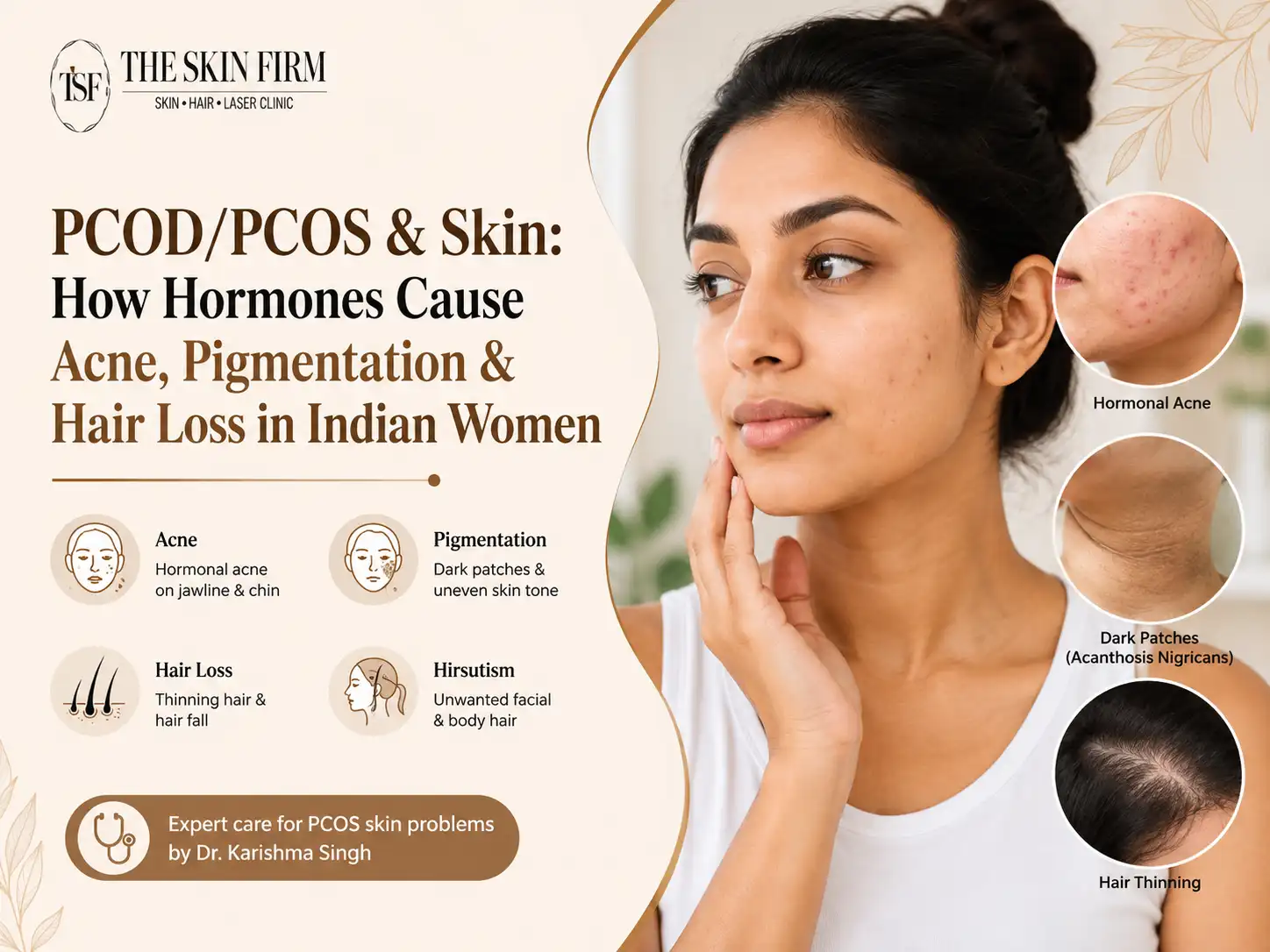
PCOD (Polycystic Ovarian Disease) and PCOS (Polycystic Ovarian Syndrome) affect approximately 1 in 5 Indian women — making it one of the most prevalent hormonal conditions in the country. While PCOS is widely discussed in the context of menstrual irregularity and fertility, its impact on the skin and hair is equally significant and often more visible in daily life.
At The Skin Firm — South Pune's best skin clinic and aesthetic clinic — Dr. Karishma Singh, skin specialist and aesthetic dermatologist, treats a large number of patients whose skin concerns are directly linked to PCOD or PCOS. This guide explains how PCOS affects the skin and hair, and what the most effective skin care treatments are for Indian women dealing with hormonally-driven skin concerns in 2026.
How PCOS Affects the Skin: The Hormonal Mechanism
PCOS is characterised by elevated androgen levels (male hormones like testosterone and DHT) in women. These excess androgens directly affect skin and hair in three major ways:
1. Stimulate sebaceous (oil) glands to overproduce sebum — causing oily skin, clogged pores, and acne
2. Trigger follicular miniaturisation in scalp hair — causing androgenetic alopecia (female pattern hair thinning)
3. Activate terminal hair growth on the face and body (hirsutism) — unwanted facial and body hair
Additionally, insulin resistance — present in 50-70% of PCOS patients — causes a condition called acanthosis nigricans: velvety dark patches in skin folds like the neck, underarms, and groin. This is a direct skin manifestation of the underlying metabolic disruption in PCOS.
Skin Concern 1: Hormonal Acne in PCOS — Why It's Different
PCOS-related acne is distinct from typical teenage acne in its pattern, severity, and treatment response. Understanding these differences helps explain why generic acne treatments often fail PCOS patients:
- Location: PCOS acne classically appears along the lower face — jawline, chin, and lower cheeks — corresponding to the areas most sensitive to androgen stimulation. Standard acne typically presents on the forehead and mid-face.
- Cycle Correlation: PCOS acne is often cyclical — worsening in the week before menstruation when progesterone and androgens peak, and improving (partially) after menstruation begins.
- Type: Predominantly deep, inflamed papules, pustules, and nodules — not the surface-level blackheads common in teenage acne. These deep lesions are more painful, take longer to heal, and carry a higher risk of post-inflammatory hyperpigmentation (PIH) on Indian skin.
- Treatment Response: PCOS acne does not respond adequately to antibiotics alone or standard topical acne treatment without addressing the underlying hormonal driver. Effective treatment requires combining medical hormonal management (prescribed by a gynaecologist or endocrinologist) with dermatological acne skin care treatment from a skin specialist.
Best Acne Skin Care Treatments for PCOS at The Skin Firm
- Prescription Topical Protocol: Combination of adapalene (retinoid), benzoyl peroxide, and niacinamide — prescribed by Dr. Karishma Singh after assessing your skin type and PCOS severity. Prescription-strength topicals outperform OTC products significantly.
- Salicylic Acid Chemical Peels: 20-30% salicylic acid peels are ideal for PCOS acne — anti-inflammatory, keratolytic, and antibacterial. Regular sessions at The Skin Firm skin care clinic significantly reduce active breakouts and improve PIH marks. More at: theskinfirm.in/acne-treatment-in-pune/
- HydraFacial (Monthly): Deep cleansing and sebum extraction via HydraFacial helps PCOS patients manage congested pores and prevent new breakouts. Includes a salicylic acid infusion step for oily, acne-prone skin. More at: theskinfirm.in/hydrafacial-in-pune/
- MNRF for Acne Scars: For patients with established atrophic acne scars from PCOS-related breakouts, Microneedling with Radiofrequency (MNRF) is the most effective treatment — safe for Indian skin and producing significant scar improvement over 4-6 sessions.
Skin Concern 2: Acanthosis Nigricans & Hyperpigmentation in PCOS
Acanthosis nigricans — the velvety dark, thickened skin appearing in body folds — is directly caused by insulin resistance in PCOS patients. It is most common at the back of the neck, underarms, inner thighs, and knuckles. Unlike regular pigmentation, acanthosis nigricans has a textural component (raised, rough skin) alongside the colour change.
Treatment focuses on two levels: addressing the underlying insulin resistance (through diet, exercise, and medication prescribed by your physician) and improving the skin's appearance through chemical peels, laser toning, and skin brightening treatments at a qualified aesthetic clinic.
PCOS patients are also significantly more prone to post-inflammatory hyperpigmentation (PIH) — dark marks left after acne breakouts — due to Indian skin's higher melanin reactivity. Chemical peels and Q-Switch laser toning at The Skin Firm are the most effective treatments. More at: theskinfirm.in/skin-pigmentation-melasma-treatment-in-pune/
Skin Concern 3: Hair Loss in PCOS — Androgenetic Alopecia in Women
Female pattern hair loss associated with PCOS is caused by DHT (dihydrotestosterone) sensitivity of scalp hair follicles — identical in mechanism to male pattern baldness but presenting differently. In women, it typically manifests as diffuse thinning at the crown and widening of the hair parting, rather than the receding hairline pattern seen in men.
At The Skin Firm, Dr. Karishma Singh and our skin experts assess PCOS-related hair loss through trichoscopy before recommending any treatment. Effective options include:
- GFC Therapy (Growth Factor Concentrate): A higher-potency evolution of PRP — delivers concentrated growth factors directly to miniaturised follicles, stimulating regrowth. 3-6 monthly sessions, followed by maintenance every 4-6 months. More at: theskinfirm.in/gfc-therapy-in-pune/
- PRP (Platelet-Rich Plasma) Therapy: Uses the patient's own growth factors to stimulate dormant follicles. Effective for early to moderate androgenetic alopecia in PCOS patients. More at: theskinfirm.in/hair-loss-treatment-in-pune/
- QR678 and Hair Mesotherapy: Growth factor cocktail injections delivered directly to the scalp — promotes follicle health and reduces further miniaturisation.
- Medically Supervised Topical Minoxidil: Prescription 2-5% topical minoxidil, often combined with other treatments for synergistic effect. Must be used continuously — stopping leads to reversal.
Skin Concern 4: Unwanted Facial & Body Hair (Hirsutism) in PCOS
Androgen-driven terminal hair growth on the chin, upper lip, jawline, chest, abdomen, and arms is one of the most distressing symptoms of PCOS for women. Waxing and threading provide temporary relief but stimulate more prominent regrowth over time and cause PIH in darker Indian skin.
Laser hair removal — specifically Nd:YAG 1064nm laser at The Skin Firm — is the safest and most effective long-term solution for hirsutism in PCOS patients with Indian skin. Because PCOS causes ongoing hormonal stimulation of hair follicles, PCOS patients typically require more sessions (8-10) than non-PCOS patients and may benefit from annual maintenance sessions. More at: theskinfirm.in/laser-hair-removal-in-pune/
Managing PCOS Skin: The Holistic Approach
The most effective approach for PCOS skin management combines dermatological skin care treatments with lifestyle modifications that address the underlying hormonal and metabolic disruption:
• Low glycaemic index (GI) diet — reduces insulin spikes that worsen PCOS symptoms and acne
• Regular exercise — improves insulin sensitivity, reducing androgen levels naturally
• Stress management — chronic stress elevates cortisol, which worsens hormonal imbalance
• Adequate sleep — hormonal regulation occurs primarily during sleep
• Medical management — Metformin, oral contraceptives, or anti-androgens prescribed by your physician work in combination with skin care treatments for comprehensive PCOS management
At The Skin Firm, Dr. Karishma Singh takes a holistic, integrated view of PCOS skin concerns — addressing both the dermatological symptoms and helping patients understand the lifestyle factors that influence their skin's behaviour.
Book Your PCOS Skin Consultation at The Skin Firm
PCOS skin concerns require a skin expert who understands the hormonal context, not just the skin symptoms. At The Skin Firm — South Pune's best aesthetic clinic and skin care clinic — Dr. Karishma Singh creates personalised skin care treatment plans that address acne, pigmentation, hair loss, and hirsutism together. Book your consultation at our best skin clinic in Mohammed Wadi, South Pune.
Book Your Consultation at The Skin Firm
Ready to start your skin care journey? Visit The Skin Firm — South Pune's best skin clinic — for personalised skin care treatments by our expert skin specialists.
📍 1st Floor, Society Gate 1, Plot no.1, NIBM Post Office Rd, opp. Tribeca Highstreet, Mohammed Wadi, Pune 411060
📞 +91 8308669966
🕐 Tuesday – Sunday: 10:00 AM – 8:00 PM | Monday: Closed
📅 Arrive 15 minutes early · 24-hour cancellation notice required