 Add as a preferred source on Google
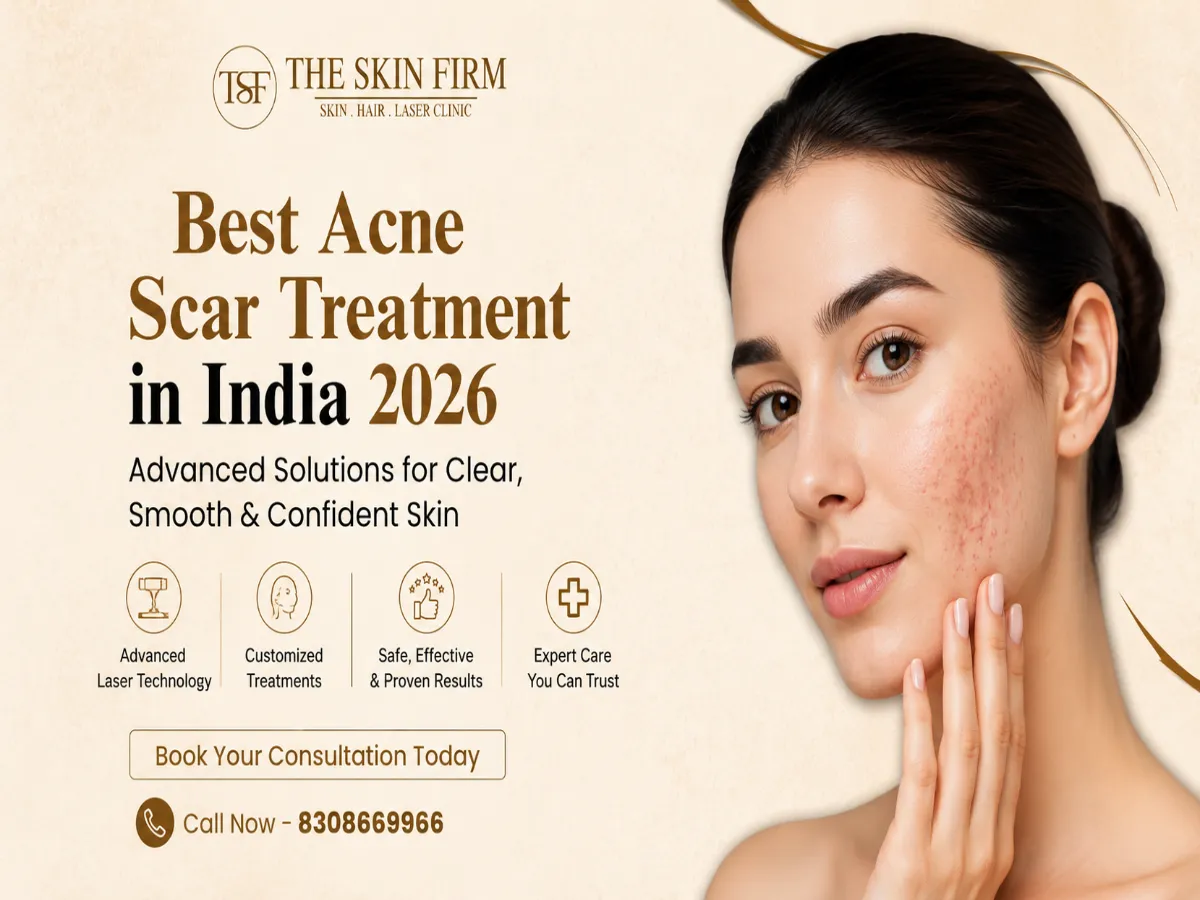
Acne scars are a visible reminder of breakouts that have healed. For many people in India dealing with ice pick scars, boxcar craters, rolling depressions and dark post-inflammatory marks, the practical question is which treatment suits their particular scar type and skin tone.
At The Skin Firm, a skin, hair and laser clinic at NIBM Mohammed Wadi, Dr. Karishma Singh, Skin & Aesthetic Specialist and Founder, assesses acne scars at the consultation. This guide explains the main treatment options, what to realistically expect, and how to choose between them. See also our skin specialist in Mohammed Wadi page.
Understanding Acne Scars: Types and Why Treatment Differs
Not all acne scars are the same, and the suitable treatment depends on your scar type. A proper assessment by a doctor is important before any procedure:
- Ice Pick Scars: Deep, narrow, V-shaped pits that extend into the dermis. These are among the harder scars to treat. Options doctors consider include TCA CROSS (trichloroacetic acid applied precisely into the pit) and microneedling with radiofrequency.
- Boxcar Scars: Wide, U-shaped depressions with well-defined edges. They respond well to fractional laser resurfacing (CO2 laser), microneedling, and MNRF.
- Rolling Scars: Wave-like skin undulations caused by fibrous bands beneath the skin. Subcision (a minor procedure that releases the bands), sometimes combined with fillers or microneedling, is one option doctors consider.
- Post-Inflammatory Hyperpigmentation (PIH): Flat dark marks left after acne heals, which are not true scars. Options include chemical peels, topical brightening agents and, in some cases, laser toning, chosen after assessing your skin.
- Hypertrophic and Keloid Scars: Raised, thickened scar tissue above the skin surface. These are less common and are managed differently, for example with steroid injections, laser or silicone gel, as decided by the doctor.
Acne Scar Treatment Options: What Each Is Used For
1. Microneedling with Radiofrequency (MNRF) for Atrophic Scars
MNRF combines microneedling — fine needles that create controlled micro-channels in the skin — with radiofrequency energy delivered into the dermis to stimulate collagen. It is one of the options considered for atrophic scars (ice pick, boxcar, rolling). Because it can still cause temporary redness and, in some skin, pigmentation changes, settings are chosen for your skin tone. Several sessions spaced weeks apart are usually needed; the number is advised at the consultation. Results vary from person to person.
2. Fractional CO2 Laser Resurfacing for Boxcar and Rolling Scars
Fractional CO2 laser creates microscopic treatment zones in the skin, removing damaged outer layers and prompting new collagen formation. It is used for some boxcar and rolling acne scars.
On Indian skin, settings and session spacing matter because aggressive settings can cause post-inflammatory hyperpigmentation. The doctor who performs the laser and the settings used are confirmed at the consultation.
3. Chemical Peels for PIH, Mild Scars and Skin Texture
Chemical peels are one option when the main concern is dark marks rather than structural scars. If acne is still active, see our acne treatment page first.
Salicylic acid peels are commonly used on oily, acne-prone skin, glycolic acid peels for surface exfoliation, and TCA peels at varying strengths for more significant concerns. Several sessions are usually needed, and the type and strength are chosen after assessing your skin.
4. Microneedling (Collagen Induction Therapy) for Mild to Moderate Scars
Standard microneedling uses fine needles to create controlled micro-injuries that prompt collagen and elastin production. It is used for mild to moderate atrophic scars. Results are gradual, mild redness for a day or two is common, and the number of sessions is advised at the consultation. Skin tone and any active acne are assessed first.
5. PRP (Platelet-Rich Plasma) for Acne Scars
PRP uses a person’s own blood, centrifuged to concentrate growth factors, which is then applied or injected into the skin. It is usually combined with microneedling rather than used alone. Because it is prepared from your own blood, allergic reactions are less likely, but bruising, swelling and infection are still possible, and evidence for acne scars is limited. Your doctor will explain what to expect.
How to Choose the Right Acne Scar Treatment for You
The most important step before any acne scar treatment is an assessment by a qualified doctor who can identify your scar types, skin tone and medical history. Choosing treatments from social media without professional guidance can lead to disappointment or side effects. At The Skin Firm, the assessment looks at scar type, depth and skin tone before a combination plan is suggested. See our acne treatment options too.
Book Your Acne Scar Treatment Consultation in South Pune
The Skin Firm, NIBM Road, Pune offers consultations for acne scars. Which treatments suit you, and which doctor performs them, is confirmed at the consultation. Learn more about acne scar and mark treatment or the CO2 laser option.
Book Your Consultation at The Skin Firm
Ready to discuss your skin? Visit The Skin Firm for a consultation with our doctors.
Contact The Skin Firm
- 📍 1st Floor, Society Gate 1, Plot no.1, NIBM Post Office Rd, opp. Tribeca Highstreet, Mohammed Wadi, Pune 411060
- 📞 +91 8308669966
- ✉ hello@theskinfirm.in
- 🕐 Tuesday – Sunday: 10:00 AM – 8:00 PM | Monday: Closed
- 📅 Appointment Policy: Please arrive 15 minutes early. 24-hour cancellation notice required.
- 🌐 theskinfirm.in