 Add as a preferred source on Google
Written by The Skin Firm clinical content team · Reviewed by Dr. Karishma Singh, BHMS, FCHD (Founder, Skin & Aesthetic Specialist) · Reviewed on 13 November 2026
Quick answer
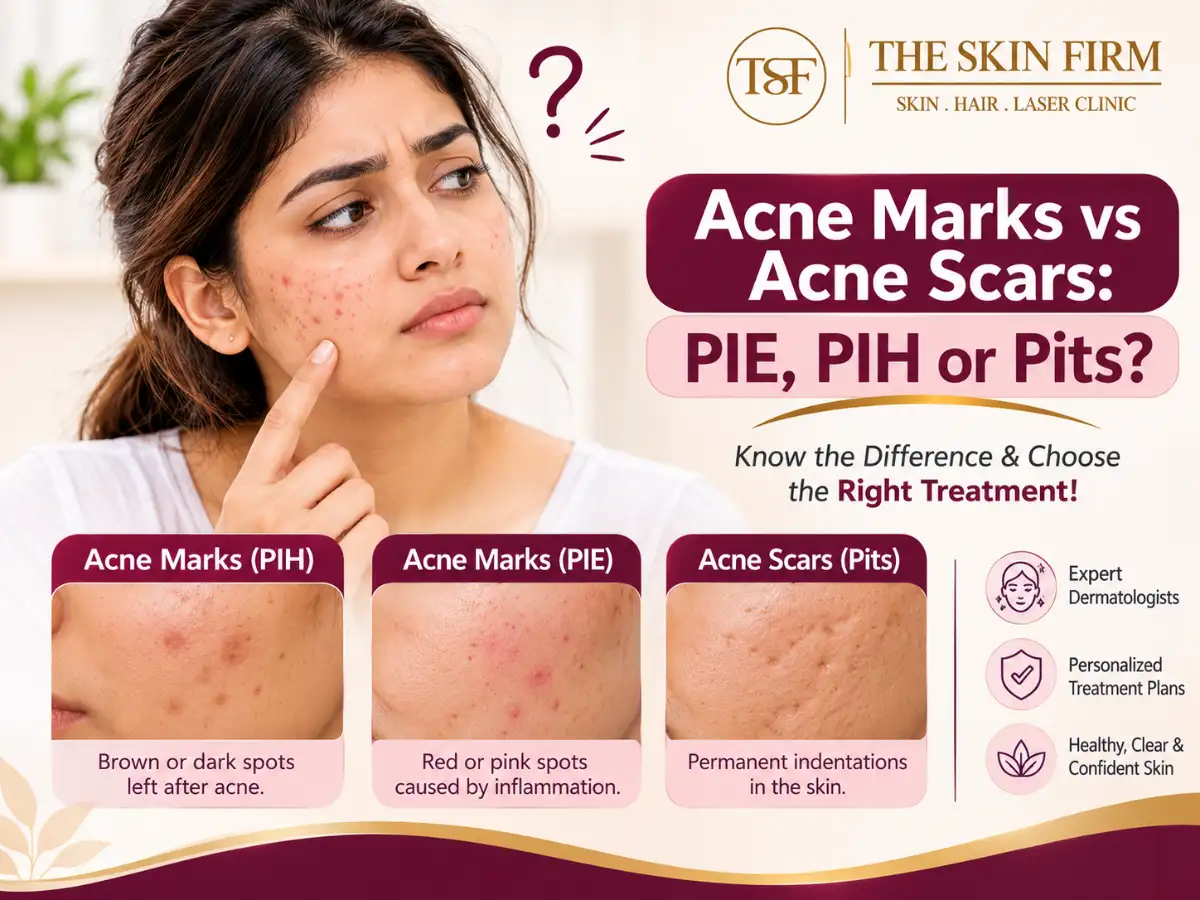
Acne marks are flat colour changes; acne scars change the skin's texture. Red or pink flat marks are post-inflammatory erythema (PIE) and usually fade when pressed under a glass. Brown or dark flat marks are post-inflammatory hyperpigmentation (PIH), very common in Indian skin. Pits or dents (ice pick, boxcar, rolling) and raised bumps are true scars. Marks often fade over months; scars rarely improve much without treatment.
Most people in Pune who say "acne scars" are actually describing a mix of red marks, brown marks and a few true pits. Getting the label right matters, because flat marks and dented scars respond to very different things. This guide shows you how to sort your own marks at home before you see a doctor. For assessment and treatment, see our acne scars and marks treatment in Pune page.
Marks or scars: what's the actual difference?
A mark is a change in colour. A scar is a change in structure, where collagen under the skin was lost or overproduced while a pimple healed.
The simplest check is touch. Run a clean fingertip over the spot. If it feels the same as the skin around it, it is almost certainly a mark.
The American Academy of Dermatology notes that a flat spot of colour left after acne is usually not a scar. It tends to fade, while a true scar stays.
Red or pink marks (PIE): what they are and the glass test
Post-inflammatory erythema, or PIE, is redness left behind by small blood vessels that widened during the pimple. It is flat and pink, red or purplish, and is easier to see on fairer skin. On brown skin it is often hidden under or mixed with PIH.
Try the glass test (also called the pressure test):
- 1. Take a clear drinking glass or a clean glass slide.
- 2. Press it gently but firmly over the mark in good daylight.
- 3. Look through the glass. If the redness fades or turns pale under pressure, it is likely PIE.
- 4. If a brown or grey colour stays visible, that part is pigment (PIH).
PIE often fades by itself over several months, though it can linger longer. Scrubbing, picking and harsh actives keep the skin inflamed and the redness going.
Brown or dark marks (PIH): why Indian skin gets them more
Post-inflammatory hyperpigmentation, or PIH, is extra melanin left after inflammation. It ranges from light brown to almost black. Deeper pigment can look grey or bluish. Pressing with a glass does not make it disappear.
DermNet notes that PIH is more common, more intense and longer-lasting in darker skin. Most Indian skin is Fitzpatrick type IV to V, with active pigment cells that react strongly to any inflammation. Pune's strong sun then darkens these marks further.
Common local habits make PIH worse:
- Picking or squeezing pimples, which deepens inflammation.
- Rubbing lemon, toothpaste, baking soda or raw garlic on spots.
- Using chemist-bought "fairness" or mixed creams that contain steroids.
- Skipping sunscreen on cloudy monsoon days or during the commute.
Shallow PIH may fade over a few months. Deeper pigment can take a year or longer, and results vary from person to person.
Pitted scars: ice pick, boxcar and rolling
Atrophic (depressed) scars form when too little collagen is rebuilt after a deep, inflamed breakout. An Indian review in the Journal of Cutaneous and Aesthetic Surgery estimates that atrophic scars make up about 80-90% of acne scars. Most people have more than one type.
- Ice pick scars: narrow, deep holes, like an enlarged pore or a needle prick. They are the most common type.
- Boxcar scars: round or oval dents with sharp, steep edges and a flat floor. They are wider than ice pick scars.
- Rolling scars: wide, shallow, soft-edged dips that make the skin look wavy. Bands under the skin tether the surface down.
Use the side-light test. In a dark room, hold your phone torch at the side of your face, almost parallel to the skin. Pits cast small shadows that flat marks do not. Gently stretching the skin also helps: rolling scars tend to soften when stretched, while ice pick scars stay visible.
Raised scars: hypertrophic scars and keloids
Raised scars form when the skin makes too much collagen. The AAD notes they are more common in darker skin tones.
- Hypertrophic scars: firm, raised bumps that stay within the area of the original pimple. They often appear on the jawline, chest or back, usually a month or two after the breakout settles.
- Keloids: raised, shiny, sometimes itchy scars that grow beyond the original spot. They favour the chest, shoulders, upper back and jaw, and can appear months later.
Small skin-coloured bumps on the nose or chin can also be scars. If a "pimple" never comes to a head or changes, get it checked.
Acne marks vs acne scars: comparison table
- PIE (red mark): What it is: Widened small blood vessels; How it looks: Flat pink, red or purple; Test at home: Fades under pressed glass; Fades on its own?: Often, slowly; Typical timeline: Several months, sometimes longer; What helps: Calm skin, sunscreen, time; vascular lasers or topicals in some cases
- PIH (brown mark): What it is: Extra melanin; How it looks: Flat brown, dark or grey; Test at home: Stays under glass; feels smooth; Fades on its own?: Often, slowly; Typical timeline: A few months to a year or more; What helps: Sunscreen, azelaic acid, retinoids, niacinamide, superficial peels
- Ice pick scar: What it is: Deep, narrow tissue loss; How it looks: Small deep hole; Test at home: Shadow with side light; stays when stretched; Fades on its own?: No, rarely improves much; Typical timeline: Long-lasting without treatment; What helps: TCA CROSS, punch techniques
- Boxcar scar: What it is: Tissue loss with steep edges; How it looks: Round or oval dent, flat base; Test at home: Clear shadow edge with side light; Fades on its own?: No; Typical timeline: Long-lasting without treatment; What helps: Microneedling, RF microneedling, fractional CO2 laser
- Rolling scar: What it is: Skin tethered by bands below; How it looks: Wide, wavy dips; Test at home: Softens when skin is stretched; Fades on its own?: No; Typical timeline: Long-lasting without treatment; What helps: Subcision, often with microneedling or laser
- Hypertrophic or keloid: What it is: Excess collagen; How it looks: Firm raised bump or growing lump; Test at home: Raised to the touch; Fades on its own?: Hypertrophic may flatten slowly; keloids rarely; Typical timeline: Months to years; What helps: Steroid injections, silicone, other doctor-led options
Why the distinction changes your treatment
Marks sit in the colour layer of the skin. Sun protection, pigment-targeting creams and gentle peels can help them fade faster.
Pits sit in the structure of the skin. No cream fills a hole, so pitted scars need collagen-stimulating procedures such as microneedling, radiofrequency microneedling, fractional lasers or subcision.
Mixing them up wastes time. People use "scar removal" creams for months on pits, or book lasers for brown marks that sunscreen would have faded. On brown skin, aggressive procedures can also trigger fresh PIH.
First steps for any mark or scar
- 1. Treat active acne first. Every new inflamed pimple can leave a new mark or scar. See our acne treatment in Pune options.
- 2. Use sunscreen every day. Apply a broad-spectrum SPF 50 each morning and reapply when outdoors. UV darkens PIH and slows fading.
- 3. Don't pick or squeeze. The AAD lists picking as a key risk factor for scarring.
- 4. Avoid kitchen remedies. Lemon, toothpaste and baking soda irritate skin and can darken marks.
- 5. Avoid unlabelled or steroid creams. Mixed creams sold over the counter can thin skin and cause rebound problems.
- 6. Be patient. Give flat marks a few months of good basic care before judging them.
What helps each type: a brief overview
This is an overview, not a treatment plan. A doctor will match options to your skin type and scar pattern. Results vary, and most people need a combination over several sessions.
Flat brown marks (PIH). Doctors commonly use azelaic acid, niacinamide and retinoids such as adapalene or tretinoin. Retinoids can irritate and are avoided in pregnancy. Hydroquinone is sometimes prescribed short-term under supervision because misuse can cause problems. Superficial chemical peels can speed fading. Please don't self-medicate with prescription creams.
Red marks (PIE). Many fade with time and gentle care. For persistent redness, a systematic review found vascular lasers and light devices most studied, with some topical agents also showing promise. Ask your doctor which options suit you.
Pitted scars. Options include microneedling, radiofrequency microneedling, fractional CO2 laser, subcision for rolling scars and TCA CROSS for ice pick scars. The JCAS review notes combinations work better than single treatments. It also notes that fractional CO2 and TCA CROSS can cause PIH in darker skin, so settings and sun care matter. Read whether acne scars can be removed completely and how many sessions acne scar treatment takes for realistic expectations.
Raised scars. These need a doctor's care. Options include steroid injections and silicone products, and keloids can recur.
For a Hindi-language overview of "daag" and their treatment, see our chehre ke daag guide.
When to see a doctor
- You can't tell whether a spot is a mark, a scar or active acne.
- You have pits, dents or raised scars.
- Marks are not fading after three to six months of sunscreen and basic care.
- A scar is growing, itching, painful or spreading beyond the original spot.
- You still get deep, painful or cystic pimples.
- A close family member has acne scars, which raises your own risk.
You can book a consultation at The Skin Firm, a skin, hair and laser clinic at NIBM Road, Pune, to have your marks and scars assessed by a doctor. Your plan will be matched to your scar type and skin tone.
References
- Acne scars: Signs and symptoms — American Academy of Dermatology
- Postinflammatory hyperpigmentation — DermNet
- Acne scarring — DermNet
- Evidence-based surgical management of post-acne scarring in skin of color — Journal of Cutaneous and Aesthetic Surgery (Gupta A, Kaur M, Patra S, Khunger N, Gupta S, 2020)
- Post-acne erythema treatment: A systematic review of the literature — Journal of Cosmetic Dermatology (Kalantari Y et al., 2022)
This article is for general information and isn't a substitute for a medical consultation. Editorial note: drafted with AI assistance and medically reviewed before publication.