 Add as a preferred source on Google
Written by The Skin Firm clinical content team · Medically reviewed by Dr. Monica C., MD (Dermatology, Venereology & Leprosy) · Reviewed on 16 October 2026
Quick answer
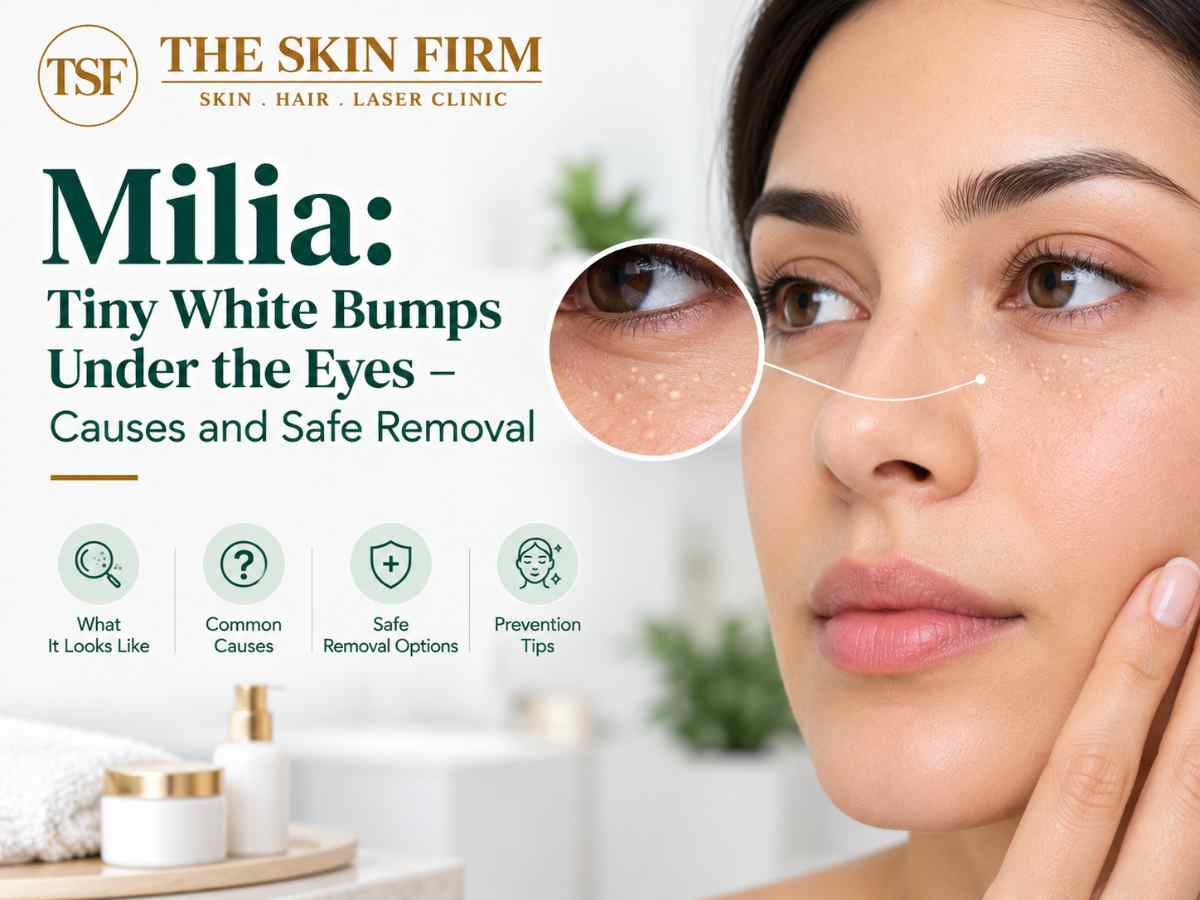
Milia are tiny, hard, white or yellowish bumps, usually 1–2 mm, that form when keratin (a skin protein) gets trapped just under the surface. They're most common under the eyes, on the eyelids, cheeks and nose. They're harmless and not acne, so squeezing doesn't work and can scar. Many go away on their own over months. If they persist, a doctor can remove them with sterile extraction, or treat them with prescription creams, peels or laser.
Milia look like whiteheads, but they behave very differently. You can press on them for days and nothing comes out. That's because there's no opening to the surface: the white material is sealed under a thin layer of skin. This guide explains why milia form, how to tell them from other small bumps around the eyes, and the safe ways to get rid of them. Removal of small skin growths is part of our mole and skin tag removal service.
What are milia?
A milium (the singular of milia) is a tiny cyst filled with keratin, the protein that makes up the outer layer of skin and hair. Normally, dead skin cells shed from the surface. When they get trapped in a small pocket just below the surface, they form a firm, pearl-like white bump.
Milia are:
- Small, usually 1–2 mm
- White to yellowish, and firm or hard to the touch
- Usually not painful or itchy
- Found mainly around the eyes, on the eyelids, cheeks, nose and forehead
- Common at any age, from newborn babies to older adults
They aren't infected, contagious or related to hygiene.
Types of milia
Primary milia form on their own, without any skin damage. They're very common in newborns (often called "milk spots") and usually disappear within a few weeks without treatment. In adults, primary milia often appear around the eyes and cheeks and can last for months or longer.
Secondary milia develop after the skin has been damaged or irritated, when the healing process traps keratin. Triggers include:
- Burns, blistering rashes or skin injuries
- Procedures such as dermabrasion, some lasers or deep peels
- Long-term use of strong steroid creams on the face
- Long-term sun damage
- Heavy, rich creams around the eyes in some people
Milia en plaque is a rare form in which many milia cluster on a raised patch, often behind the ears or on the eyelids. It needs a doctor's assessment.
Milia vs whiteheads and other small bumps
Several small bumps appear around the eyes and cheeks. Telling them apart matters, because some must never be squeezed or cut.
- Milia: What it looks like: Hard, pearly white, 1–2 mm; How it differs: No opening; doesn't come out when squeezed
- Whitehead (closed comedo): What it looks like: Soft, skin-coloured or white bump; How it differs: Part of acne; usually on oily areas; may come with blackheads
- Syringoma: What it looks like: Skin-coloured or yellowish small bumps, usually under the eyes, often in clusters; How it differs: Benign sweat-duct growths; can't be extracted like milia
- Xanthelasma: What it looks like: Flat, soft yellow patches on the eyelids; How it differs: Cholesterol deposits; may need a blood cholesterol check
- Sebaceous hyperplasia: What it looks like: Yellowish bump with a tiny central dip, on forehead or cheeks; How it differs: Enlarged oil gland, more common after 40
- Molluscum contagiosum: What it looks like: Pearly, dome-shaped bump with a central dimple; How it differs: Viral; can spread with scratching or shaving
If you have small bumps around your eyes and aren't sure what they are, have them examined before trying any treatment.
Why do I keep getting milia under my eyes?
The skin around the eyes is thin and sheds slowly, so it's a common site. Several habits can make milia more likely:
- Heavy or rich eye creams that sit on the skin and slow normal shedding
- Not removing eye makeup properly, especially waterproof products
- Sun exposure without protection, which thickens and damages skin over time
- Steroid creams used around the eyes without medical supervision
- Rubbing the eyes frequently, for example with allergies
Some people are simply more prone to milia and get them even with careful skincare.
Why you shouldn't squeeze or pick milia
Because milia have no opening, squeezing just presses the skin around them. Trying to break the skin at home with a pin or needle can cause:
- Infection
- Scarring and pitted marks
- Dark marks, which are common in Indian skin
- Injury to the eyelid or eye, which is especially risky around the lash line
A milium removed properly by a doctor is usually quick and typically leaves only a small mark. A milium attacked at home can leave a scar for years.
How milia are treated
Wait and watch. In newborns, milia almost always clear on their own within weeks. In adults, many clear over months as the skin naturally sheds. If they don't bother you, leaving them alone is a perfectly reasonable choice.
Sterile extraction (deroofing). A commonly used treatment. A doctor cleans the skin, makes a tiny opening with a sterile needle or blade and gently presses out the keratin. It's quick and usually needs no numbing. Tiny marks heal within a few days.
Prescription retinoid creams. For many milia, or for people who keep getting new ones, a retinoid cream can speed up skin turnover and help prevent new milia. Retinoids can irritate the delicate skin around the eyes, so a doctor will advise how and where to use them.
Chemical peels. Superficial peels can help when milia are spread across the cheeks or forehead. They aren't usually used on the eyelids. Learn more on our chemical peel page.
Electrocautery or laser. For stubborn or numerous milia, a doctor may use fine electrocautery or an ablative laser such as CO2 laser to open and clear them.
Cryotherapy. Freezing is sometimes used, though it's less favoured in darker skin because of the risk of light patches.
The right option depends on how many milia you have, where they are and whether new ones keep forming. Laser and electrocautery are medical procedures, and the doctor who performs them is confirmed at the consultation.
What to expect after extraction
- Tiny pinpoint marks or small scabs for 2–5 days
- Mild redness for a few hours
- Many people go back to work the same day
- Avoid eye makeup on the treated spots for a day or two
- Use sunscreen to prevent dark marks while the skin heals
Can I use milia removal products at home?
Gentle exfoliating products with low-strength AHAs or retinol (used away from the lash line) may help the skin shed more normally and reduce new milia over time. They rarely remove existing milia quickly. Avoid "extraction tools", needles and scrubs around the eyes.
How to prevent milia
- 1. Choose a light, non-comedogenic eye cream, or skip eye cream if you don't need it
- 2. Remove eye makeup gently and completely every night
- 3. Use sunscreen daily, including around (not in) the eyes, and wear sunglasses
- 4. Don't use steroid creams on the face unless a doctor has prescribed them
- 5. If you've had laser or peels, follow aftercare carefully and avoid very heavy creams afterwards unless advised
- 6. Ask your doctor about a gentle retinoid if you get milia repeatedly
Milia in babies
Up to half of newborns have milia, usually on the nose, cheeks and chin. They're harmless and clear without treatment, usually within a few weeks. Don't squeeze them or apply creams or oils. Small white spots inside a baby's mouth (on the gums or palate) are similar and also clear on their own. If spots are spreading, red, weeping or your baby seems unwell, see a paediatrician.
Milia after laser, peels or facials
Sometimes milia appear a few weeks after a resurfacing laser, a deeper peel or microneedling. As the skin heals quickly, it can trap keratin in small pockets. Thick, occlusive healing ointments used for too long can add to this.
These milia are usually few and temporary. If they appear after a procedure:
- Let your doctor know at your follow-up, rather than trying to remove them yourself
- Switch to a lighter moisturiser once the skin has healed, if your doctor agrees
- Expect most to clear with gentle care or a quick extraction
Salon facials that involve heavy creams and steaming around the eyes can trigger milia in some people. If you get milia after facials, mention it at your next appointment so the products can be changed.
Milia, makeup and eye products
- Remove eye makeup with a gentle cleanser or micellar water, without rubbing hard
- Replace old eye makeup and wash brushes regularly
- Choose products labelled non-comedogenic for the eye area
- Avoid applying face oils and thick balms right up to the lash line
- If you wear waterproof makeup daily, remove it fully every night with a suitable remover
None of these guarantee you won't get milia, but they reduce the build-up that encourages them.
Myths about milia
"Milia are a type of acne." They aren't. They're tiny cysts of trapped keratin, unrelated to oil, bacteria or hormones.
"Milia mean my skin is dirty." Hygiene doesn't cause milia. In fact, over-scrubbing around the eyes can irritate the skin.
"Steaming will make them come out." Steam softens skin but can't open a cyst that has no opening. Milia still need extraction or time.
"A scrub will remove them." Scrubs can irritate the delicate eye area and rarely affect milia under the surface.
"They're contagious." Milia don't spread from person to person. Bumps that spread when scratched may be molluscum contagiosum instead, which is why a diagnosis helps.
When to see a doctor
- Bumps have lasted several months and bother you
- You aren't sure whether they're milia or something else
- Bumps are on or close to the eyelid margin
- Many new bumps appear suddenly, or appear in a patch
- Yellow patches on the eyelids (xanthelasma) appear
- Bumps follow a burn, blistering rash or procedure
You can book a consultation at The Skin Firm, a skin, hair and laser clinic at NIBM Road, Pune, to have small bumps around the eyes examined and, if needed, treated.
References
- Milium, milia — DermNet
- Milia (milk spots): causes and treatment — Cleveland Clinic
- Milia — StatPearls, NCBI Bookshelf
This article is for general information and isn't a substitute for a medical consultation. Editorial note: drafted with AI assistance and medically reviewed before publication.