 Add as a preferred source on Google
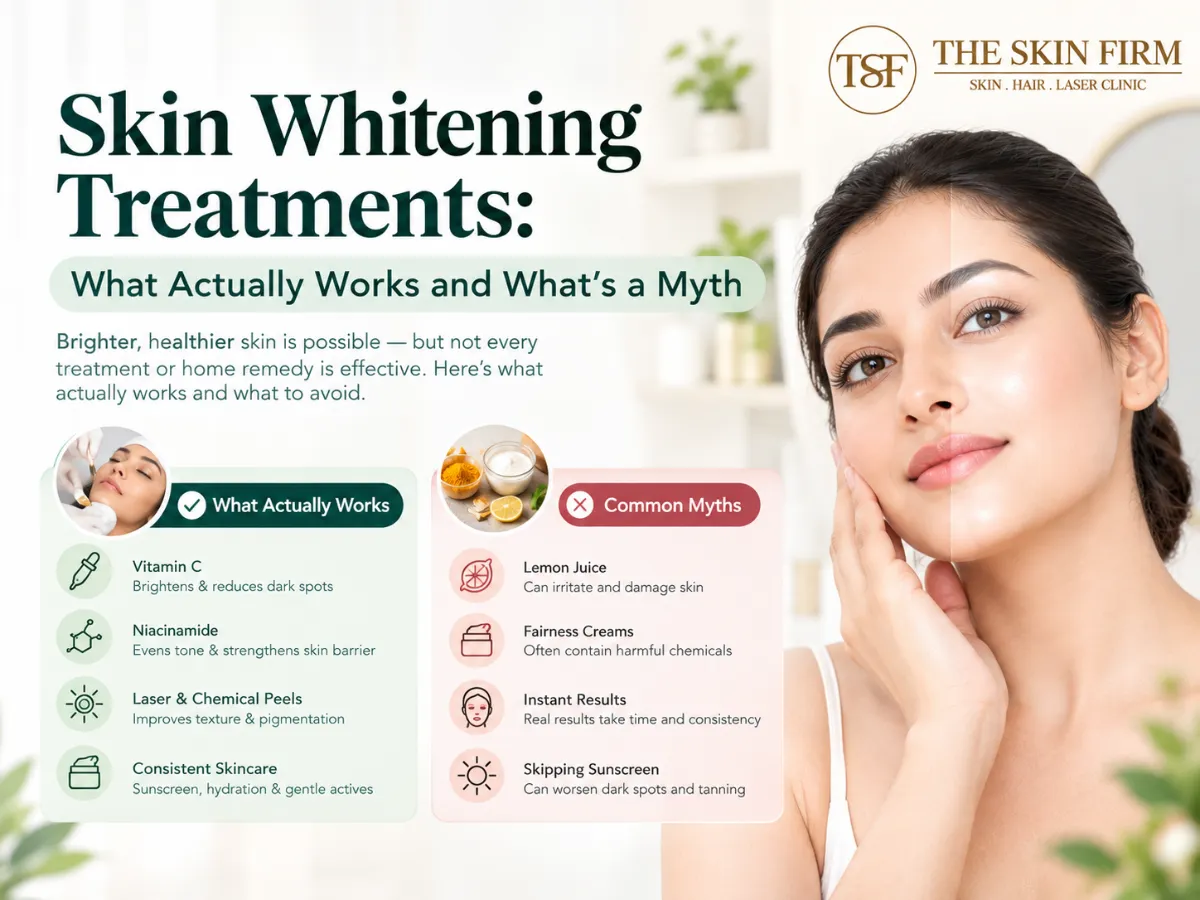
Few topics in Indian skincare attract as much confusion, misinformation, and outright false advertising as skin whitening. Walk into any pharmacy and you will find dozens of products promising quick skin lightening — claims that no legitimate dermatological treatment can honestly make. At The Skin Firm — a skin, hair and laser clinic at NIBM Mohammed Wadi — Dr. Karishma Singh, Skin & Aesthetic Specialist and Founder, separates the medical options for uneven pigmentation from the myths that continue to circulate across Indian skincare culture, so you can make an informed, safe decision.
Understanding Skin Tone: Why Complete 'Whitening' Isn't Realistic
Your baseline skin tone is determined by genetics — specifically, by the type and amount of melanin your melanocytes naturally produce. No topical product, injection or procedure can reliably change your genetic baseline skin colour by multiple shades, regardless of what marketing claims suggest. What dermatological treatments can genuinely achieve is addressing excess or uneven pigmentation — dark spots, patches, and discolouration caused by sun damage, inflammation, hormones, or melasma — bringing your skin closer to its own natural, even baseline tone rather than changing it into an entirely different complexion.
This distinction matters enormously for setting realistic expectations. A patient with naturally deep skin tone and no pigmentation irregularities has no medical basis for "whitening" treatment, because there is nothing pathological to correct — their skin tone is simply their genetic baseline. At The Skin Firm, treatment conversations focus on evening out genuine pigmentation irregularities rather than promising an unrealistic, uniform lightening effect.
Common Skin Whitening Myths — Debunked
- Myth: Over-the-counter whitening creams work permanently. Reality: Most OTC "whitening" creams contain mild exfoliants or low-concentration brightening agents that give temporary, superficial improvement at most. Stronger prescription options exist for pigmentation, but they should be prescribed and monitored by a doctor.
- Myth: Whitening injections are a safe shortcut to fairer skin. Reality: Unregulated glutathione or whitening injections sold outside proper medical supervision carry genuine risks, including allergic reactions, kidney strain from high doses, and unpredictable, patchy results. Any injectable skin treatment should only be administered by a qualified doctor after a full medical assessment.
- Myth: Natural home remedies (lemon, turmeric, besan) safely whiten skin. Reality: Lemon juice is acidic and can cause photosensitivity, chemical burns, and paradoxically worsen pigmentation when followed by sun exposure. While turmeric has mild anti-inflammatory properties, none of these home remedies have been shown to produce clinically meaningful skin lightening.
- Myth: Steroid creams are a legitimate whitening solution. Reality: Topical steroids can cause temporary lightening as a side effect, but prolonged, unsupervised use leads to skin thinning, stretch marks, visible blood vessels, and rebound darkening once discontinued. These creams are never appropriate for cosmetic whitening purposes.
- Myth: Darker skin cannot be treated with lasers or peels. Reality: Lasers and chemical peels can be used on Indian skin tones (Fitzpatrick Types III-V) when settings are chosen carefully by a qualified doctor, but they carry risks such as pigment changes, so suitability is assessed first.
What Actually Works: Evidence-Based Brightening Treatments
Treatment for uneven pigmentation focuses on identifying the cause rather than promising uniform lightening. At The Skin Firm, the options discussed at a consultation can include a prescribed topical regimen — ingredients such as niacinamide, kojic acid, azelaic acid and tranexamic acid are used for pigmentation, each acting on melanin through different pathways. These should be prescribed by a doctor at appropriate concentrations rather than self-selected from over-the-counter shelves.
Chemical peels accelerate the shedding of pigmented surface skin cells, which may gradually reveal more even-toned skin beneath. Q-Switch Nd:YAG laser toning targets melanin and is used over a series of sessions for pigmentation and dullness. Chemical peels and lasers are medical procedures, and the doctor who performs them is confirmed at the consultation. Whether these approaches are combined depends on your skin and is decided after assessment.
Understanding Your Specific Pigmentation Concern
- Sun-Related Pigmentation: Flat brown spots from cumulative UV exposure, which may be treated with Q-Switch laser toning alongside strict daily sunscreen use to reduce recurrence.
- Post-Inflammatory Hyperpigmentation (PIH): Dark marks left after acne, injury, or irritation. May be treated with chemical peels and topical brightening agents.
- Melasma: A chronic, hormonally-influenced condition causing symmetrical brown patches, typically on the face. Requires a combination approach and ongoing maintenance, as it tends to recur without consistent management.
- Uneven Overall Tone: Diffuse dullness and unevenness without distinct dark spots, often improved with regular chemical peels, HydraFacial treatments, and a consistent home brightening routine.
Why Sun Protection Is Non-Negotiable in Any Brightening Protocol
No skin brightening treatment succeeds without strict, consistent sun protection running alongside it. UV exposure directly stimulates melanin production — meaning that any progress made through peels, laser toning, or topical treatment can be undone by unprotected sun exposure, sometimes within days. This is one of the most common reasons patients feel their "whitening treatment isn't working," when in reality, inconsistent sunscreen use is actively counteracting the treatment itself.
The American Academy of Dermatology recommends a broad-spectrum, water-resistant sunscreen of SPF 30 or higher every day, reapplied about every two hours when outdoors. Consistent sun protection is one of the most important parts of managing pigmentation.
How The Skin Firm Approaches Pigmentation
At The Skin Firm, we deliberately frame every consultation around skin health and evenness rather than promoting an unrealistic "fairness" narrative. Your specific pigmentation concern — whether sun damage, PIH, melasma or general dullness — is assessed at the consultation, and options are discussed based on your skin rather than a generic package. This approach reflects broader medical ethics around cosmetic dermatology: treating identifiable skin concerns is legitimate medical practice; promising to alter someone's fundamental skin tone is not. Learn more about our approach to pigmentation specifically at skin pigmentation melasma treatment in Pune, or explore our full skin whitening service details at skin whitening treatment in Pune.
Book Your Skin Brightening Consultation at The Skin Firm
If you are dealing with genuine pigmentation concerns, rather than hoping to change your natural skin tone, a consultation at The Skin Firm can help you understand the options for your skin. Book a consultation at The Skin Firm, Mohammed Wadi, South Pune.
Book Your Consultation at The Skin Firm
Ready to start your skin care journey? Visit The Skin Firm in Mohammed Wadi, South Pune, to discuss personalised skin care with our doctors.
Contact The Skin Firm
- 1st Floor, Society Gate 1, Plot no.1, NIBM Post Office Rd, opp. Tribeca Highstreet, Mohammed Wadi, Pune 411060
- +91 8308669966
- hello@theskinfirm.in
- Tuesday – Sunday: 10:00 AM – 8:00 PM | Monday: Closed
- Appointment Policy: Please arrive 15 minutes early. 24-hour cancellation notice required.
- theskinfirm.in