 Add as a preferred source on Google
Written by The Skin Firm clinical content team · Reviewed by Dr. Karishma Singh, BHMS, FCHD (Founder, Skin & Aesthetic Specialist) · Reviewed on 12 November 2026
Quick answer
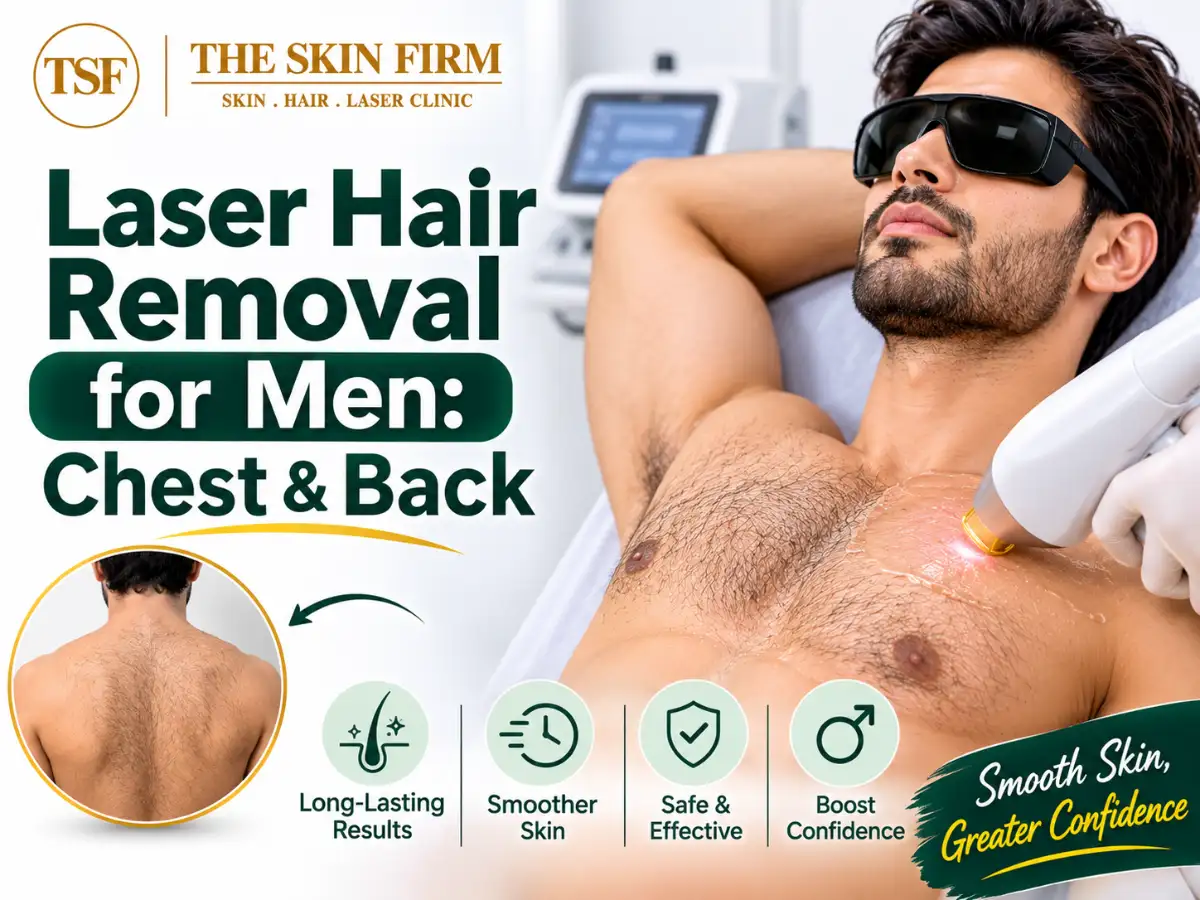
Laser hair removal for men works well on dark, coarse chest, back and shoulder hair because that hair holds plenty of pigment for the laser to target. It reduces hair rather than removing it for good. Men usually need more sessions than women, often six to eight or more, spaced 4–8 weeks apart, plus occasional maintenance. On brown skin, the laser type and settings must be chosen carefully by a trained doctor.
More men in Pune now ask about chest and back hair, often because of sweat, ingrown hairs or an upcoming wedding. Shaving your own back is awkward, and waxing gets tiring. This guide explains what laser hair removal in Pune can and cannot do for men's body hair, with honest numbers and the risks that matter on Indian skin.
Why do men choose laser hair removal for the chest and back?
- Ingrown hairs and razor bumps. Coarse, curly hair often curls back into the skin after shaving. Fewer, finer hairs mean fewer bumps. Our guide to ingrown hair treatment and prevention covers this in detail.
- Hair-related folliculitis on the back and shoulders. Some men get recurring itchy bumps around hair follicles. Reducing hair may help, but active infection or acne needs treating first.
- Sweat and odour. In Pune's humid monsoon and during gym sessions, dense body hair traps sweat. Less hair makes the skin easier to keep clean and dry.
- Grooming and sport. Swimmers, cyclists and men wanting a cleaner look tire of frequent shaving.
- Wedding season. Many grooms start between November and February. A full course takes months, so start early.
Which areas can men treat?
- Chest: What men usually want: Full clearance or thinning; Practical notes: You can ask for reduction rather than a fully bare chest
- Upper and lower back: What men usually want: Full clearance; Practical notes: Large area; sessions take longer
- Shoulders: What men usually want: Clearance; Practical notes: Hard to reach yourself; often treated with the back
- Abdomen: What men usually want: Thinning or clearance; Practical notes: Treat the "happy trail" as you prefer
- Neck and beard line: What men usually want: Cleaner edges; Practical notes: See laser beard shaping
The beard line needs extra planning. Once follicles are reduced, they don't usually come back fully, so mark the shape you want carefully.
Does laser hair removal work on men's thick hair?
Yes, coarse dark hair usually responds well. The laser targets melanin, the pigment in the hair shaft. Thick, dark hair absorbs that energy and carries heat down to the follicle, which slows regrowth.
The catch is hormones. Androgens (male hormones) keep chest and back follicles active, and many men keep recruiting new hairs into their 30s and 40s. So men often need more sessions than women and some maintenance later. Grey, white or very fine hair has little pigment and responds poorly.
How many sessions do men need for chest and back?
There is no fixed number, and results vary from person to person. Mayo Clinic says most people need four to eight treatments. The AAD quotes two to six for typical cases, spaced about 4–6 weeks apart.
For men's chest and back, plan for the upper end of these ranges or a little more. Indian dermatologists Arsiwala and Majid note that body sites often need gaps of 1–2 months. Sessions spaced too closely tend to give poorer results.
A realistic plan for a man with dense chest and back hair:
- 1. Six to eight sessions, roughly 6–8 weeks apart, over 9–12 months.
- 2. A review once the main course ends, to judge how much hair remains.
- 3. Maintenance sessions once or twice a year, if needed.
For more detail, read how many sessions laser hair removal needs.
Which lasers suit Indian skin?
Most Indian men have skin types IV–V. Brown skin also contains melanin, so it competes with the hair for laser energy. Longer wavelengths pass through the skin's surface pigment more easily.
- Diode lasers (around 800–810 nm) are widely used for brown skin when settings and cooling are adjusted. You can read about our diode laser hair removal.
- Long-pulsed Nd:YAG lasers (1064 nm) are often preferred for very dark or tanned skin, according to a review in the Indian Journal of Dermatology, Venereology and Leprology.
The Indian standard guidelines stress matching energy to skin type and recommend that a trained dermatologist carries out or directly supervises treatment. Our article on whether laser hair removal is safe for Indian skin explains this further.
What does a session feel like?
Expect some discomfort, though most men tolerate it well. Mayo Clinic describes each pulse as a quick snap, like a rubber band flicked against the skin. Coarse hair on the chest and back can feel sharper than finer hair elsewhere.
Cooling helps. Devices use a chilled tip, cooling gel or cold air to protect the skin and ease discomfort. A numbing cream is sometimes used, but only as your doctor advises.
Large areas take time: a full back can take an hour or longer, per Mayo Clinic.
What are the side effects for men?
Most reactions are mild and settle within hours to a few days.
- Redness and perifollicular swelling. Small raised bumps around each follicle are expected and usually fade within a day or two.
- Temporary pigment changes. Skin can darken or lighten for a while. Mayo Clinic notes the risk is higher on brown skin and with sun exposure.
- Blisters, crusting or burns. These are uncommon and usually linked to settings that are too strong or recent tanning.
- Acne flare or folliculitis. Some men notice a few bumps after treatment, especially on a sweaty back.
- Paradoxical hypertrichosis. Rarely, hair grows thicker near the treated area. A 2025 single-clinic review from Japan found it more often in men, mostly on the back, upper arms and shoulders. It was a small study, but it is worth discussing before treating these areas.
How should you prepare and look after your skin?
Before your session:
- Stop waxing, plucking and epilating for about four weeks. The laser needs the hair root in place.
- Shave or trim the area a day before. Don't wax.
- Avoid tanning, beach trips and pool days without cover for a few weeks.
- Tell the doctor about any medicines. Isotretinoin, often taken for back acne, and some antibiotics can make the skin more sensitive to light.
After your session:
- Skip heavy workouts, steam rooms and swimming for a day or two, or as advised.
- Use sunscreen on any treated skin exposed to the sun. Many men forget the neck and shoulders.
- Expect treated hairs to shed over one to three weeks. Don't pull them out.
How does laser compare with shaving, waxing and creams?
- Shaving: How long results last: 1–3 days; Effort for chest and back: High; back is hard to reach; Main downsides for men: Stubble, ingrown hairs, razor bumps
- Trimming: How long results last: Hair stays, only shorter; Effort for chest and back: Low; Main downsides for men: No smoothness; regrowth looks the same
- Waxing: How long results last: 3–6 weeks; Effort for chest and back: Moderate; often painful on coarse hair; Main downsides for men: Folliculitis, ingrown hairs, redness
- Hair removal creams: How long results last: A few days; Effort for chest and back: Moderate; Main downsides for men: Irritation or chemical burns on sensitive skin
- Laser hair removal: How long results last: Long-term reduction after a full course; Effort for chest and back: Clinic visits over months; Main downsides for men: Cost, multiple sessions, side effects listed above
If you plan laser, switch from waxing to shaving or trimming now.
Common myths about laser for men
- "One or two sessions will do it." Hair grows in cycles, so several sessions are needed.
- "Laser gets rid of hair for good." It is not permanent. It gives long-term reduction, and some hair can return.
- "Lasers don't work on dark skin." They can, with suitable wavelengths and careful settings.
- "It always makes hair thicker." Usually not. Paradoxical growth is a rare exception, not the rule.
- "It's only for women." Many men now seek body hair reduction.
When should you see a doctor?
See a doctor before starting if you have active acne, folliculitis, a skin infection, psoriasis, vitiligo or a history of keloids. Also check first if you take light-sensitising medicines.
After a session, seek medical advice for blisters, oozing, worsening pain, or dark patches that last beyond a few weeks. Sudden excess body hair with other symptoms may need a hormone check. Don't self-medicate with steroid or bleaching creams.
Where to get laser hair removal for men in Pune
Choose a clinic where a doctor examines your skin and hair first. The doctor should explain the laser, a likely session plan and the risks. A test patch and clear aftercare instructions are good signs.
You can book a consultation at The Skin Firm, a skin, hair and laser clinic at NIBM Road, Pune, to discuss whether laser suits your chest, back or shoulder hair.
References
- Laser hair removal — Mayo Clinic
- Laser hair removal: FAQs — American Academy of Dermatology
- Standard guidelines of care: Laser and IPL hair reduction — Indian Journal of Dermatology, Venereology and Leprology
- Methods to overcome poor responses and challenges of laser hair removal in dark skin — Indian Journal of Dermatology, Venereology and Leprology
- Gender disparities in paradoxical hypertrichosis after laser hair removal — Journal of Cosmetic Dermatology (PubMed Central)
This article is for general information and isn't a substitute for a medical consultation. Editorial note: drafted with AI assistance and medically reviewed before publication.