
 Add as a preferred source on Google
Written by The Skin Firm clinical content team · Reviewed by Dr. Karishma Singh, BHMS, FCHD (Founder, Skin & Aesthetic Specialist) · Reviewed on 10 November 2026
Quick answer
Ringworm usually keeps coming back because the fungus was never fully cleared. Common reasons are stopping the cream once the itch settles, using chemist creams that mix a steroid with an antifungal, untreated family members, and tight, sweaty clothing. Proper ringworm treatment means confirming the diagnosis, using a plain antifungal for long enough, adding prescribed tablets when needed, and treating everyone at home who has it.
Ringworm, called daad in Hindi and gajkarna in Marathi, is one of the most common skin infections dermatologists see across India. Many people have used on-and-off creams for months, and Indian dermatologists now describe an epidemic of chronic, recurrent tinea. This guide explains why it happens and what helps; you can also read about our skin treatments in Pune.
What is ringworm, and is it really a worm?
There is no worm involved. Ringworm is an infection caused by dermatophytes, a group of fungi that live on keratin, the protein in the outer skin, hair and nails.
The name comes from the ring-shaped rash it often forms. Doctors call it tinea and add the body site, such as tinea corporis on the body or tinea cruris in the groin.
It spreads through skin contact with an infected person or animal, and through shared towels, combs, clothes and bedsheets.
Why is ringworm so hard to treat in India right now?
In 2020, a task force of the Indian Association of Dermatologists, Venereologists and Leprologists (IADVL) reported a sharp rise in chronic, recurrent and steroid-modified tinea, with many cases responding less well to standard courses.
The panel defines chronic tinea as lasting six months or more. Recurrent tinea is a rash that returns within weeks of stopping treatment, after the skin looked clear. The main drivers they and other Indian authors describe are:
- Heat and humidity. Pune's monsoon and October heat keep skin folds damp for months.
- Tight synthetic clothing. Jeans, leggings, polyester gym wear and tight waistbands trap sweat and rub the skin.
- Family spread and shared items. Towels, clothes and bed linen carry spores, so one infected relative can keep reinfecting everyone else.
- A changing fungus. Indian studies show Trichophyton mentagrophytes types now rival or replace the older dominant species. These cause more inflamed rashes and survive longer on towels.
- Self-treatment. Cheap chemist creams and borrowed prescriptions are used without a diagnosis.
How do chemist creams with steroids make ringworm worse?
Many creams sold for "itching" in India combine a strong steroid, an antibiotic and an antifungal in one tube. A 2017 review in the Indian Journal of Dermatology noted these mixtures made up about half of topical steroid sales.
The steroid calms redness and itch within days, so the cream seems to work. Meanwhile it dampens the skin's local defence, and the fungus keeps spreading. When the tube runs out, the rash returns larger.
Doctors call this tinea incognito or steroid-modified tinea. The typical ring disappears, edges blur, and patches can grow very large or form rings within rings. Long use can also cause thin skin, stretch marks in the groin and thighs, and visible small blood vessels.
If a cream's label lists clobetasol, betamethasone, beclomethasone or another steroid, don't use it on a suspected fungal rash unless a doctor has told you to.
Where does ringworm appear, and how does it look on brown skin?
- Tinea corporis: Where it appears: Waist, buttocks, thighs, trunk; What people usually notice: Itchy rings, often along the waistband or underwear line
- Tinea cruris: Where it appears: Groin and inner thighs; What people usually notice: Itchy patch spreading outward, worse with sweat
- Tinea pedis: Where it appears: Feet, between toes; What people usually notice: Peeling, cracking and itching between toes
- Tinea capitis: Where it appears: Scalp, mostly in children; What people usually notice: Scaly patches, broken hairs, small bald spots
- Tinea faciei: Where it appears: Face; What people usually notice: Red or dark patches often mistaken for allergy
- Tinea unguium: Where it appears: Nails; What people usually notice: Thick, discoloured, crumbly nails
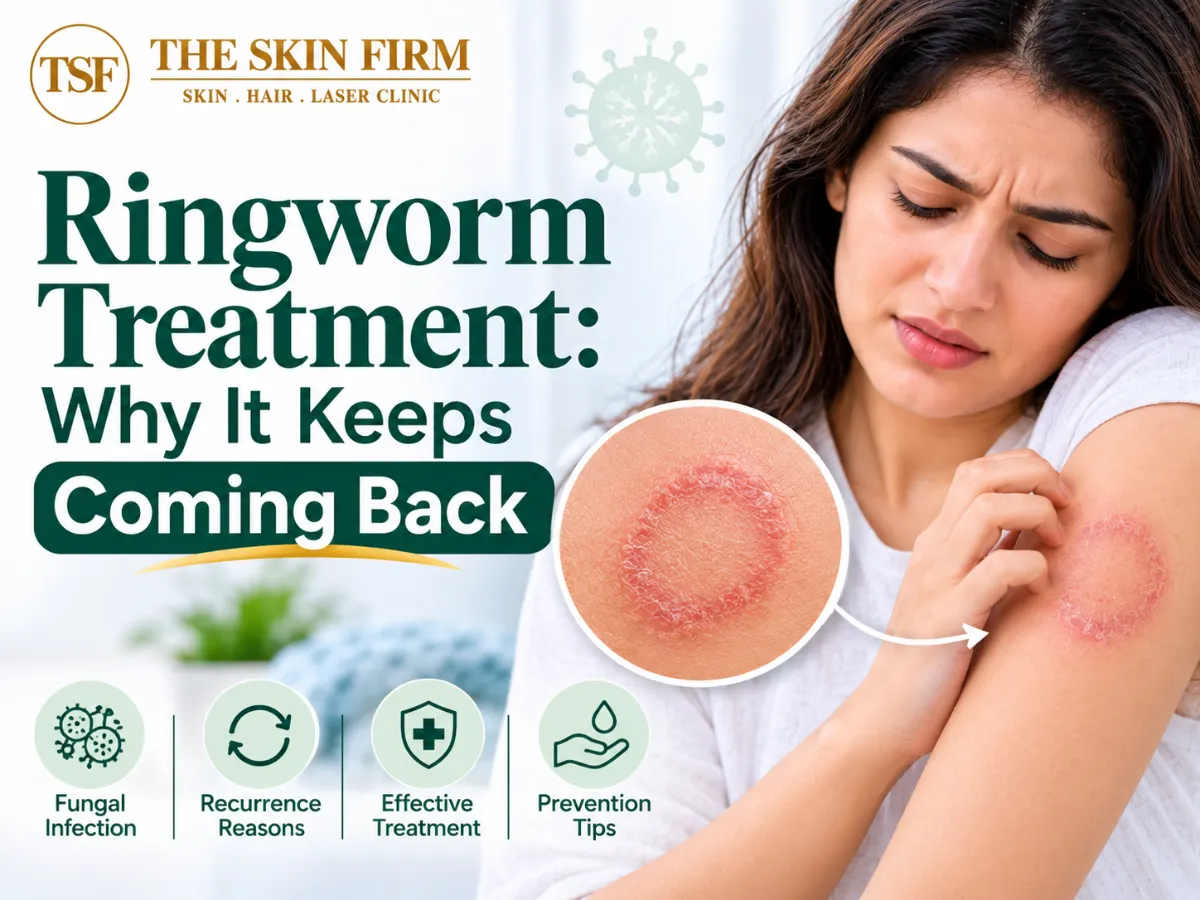
On brown skin, the redness can be hard to see. Patches often look dark brown, greyish or purplish, with a raised, scaly border and a clearer centre. The rash is often on one side only and usually itches more in heat.
Once the infection clears, dark marks can stay for several months. These marks are not active fungus and usually fade slowly.
Ringworm vs eczema vs psoriasis: how can you tell them apart?
- Shape: Ringworm (tinea): Ring with raised scaly edge, clearer centre; Eczema (discoid type): Coin-shaped, evenly scaly or oozing; Psoriasis: Well-defined thick plaques with silvery scale
- Common sites: Ringworm (tinea): Groin, waist, buttocks, feet, scalp in children; Eczema (discoid type): Arms, legs, hands; Psoriasis: Elbows, knees, scalp, lower back
- Contagious?: Ringworm (tinea): Yes, spreads to others; Eczema (discoid type): No; Psoriasis: No
- Pattern: Ringworm (tinea): Often one-sided; Eczema (discoid type): Often both sides; Psoriasis: Often both sides
- Effect of steroid cream: Ringworm (tinea): Looks better, then spreads; Eczema (discoid type): Usually improves; Psoriasis: Often improves
- KOH skin test: Ringworm (tinea): Shows fungus; Eczema (discoid type): Negative; Psoriasis: Negative
These conditions can look alike, and DermNet lists discoid eczema, psoriasis and pityriasis rosea as common mimics. Itchy bumps on the chest and back after sweating may instead be fungal acne, which is caused by a yeast. A wrong label means the wrong cream and months lost.
Why is my ringworm not healing?
Most "resistant" ringworm has a fixable reason behind it:
- You stopped when the itch stopped. Skin settles before the fungus is gone. IADVL advises continuing a cream for about two weeks after the skin looks clear.
- You applied cream only on the patch. Fungus extends beyond the visible edge, so cream should cover a margin of healthy-looking skin too.
- Someone at home still has it. Untreated family members are a common cause of what looks like treatment failure.
- Clothes and towels reinfect you. Spores survive in fabric washed cold and dried indoors.
- It isn't ringworm. Eczema or psoriasis won't respond to antifungals.
- It needs tablets. Large areas, scalp, nails and hairy skin rarely clear with creams alone.
- Your body needs support. Diabetes, a weakened immune system, steroid tablets and deep skin folds all make clearing harder.
Does ringworm go away on its own?
A small patch may occasionally fade untreated, but don't rely on it. More often it spreads to new areas and to other people.
In India's climate, and with the strains now common here, waiting usually means a larger patch. Scalp ringworm in children always needs a doctor, because it requires prescription tablets. Try not to scratch, as this can carry the fungus to other skin.
How do doctors treat ringworm that keeps coming back?
- 1. Confirm the diagnosis. A doctor examines the rash and may scrape a little scale from the edge for a KOH test, which checks the sample under a microscope for fungus. A culture is sometimes added to identify the species.
- 2. Stop the steroid mixes. IADVL recommends a plain antifungal cream, without steroid or antibiotic, applied twice daily beyond the rash margin.
- 3. Treat for long enough. The American Academy of Dermatology notes that body ringworm creams typically run two to four weeks. Chronic cases often need longer, guided by how the skin responds.
- 4. Add tablets when needed. Doctors commonly prescribe terbinafine or itraconazole, and griseofulvin for children's scalp ringworm. Possible effects include stomach upset, taste changes and rash; liver problems are rare. Itraconazole interacts with many medicines and isn't suitable for everyone, including during pregnancy. Your doctor may order blood tests and will set the course length.
- 5. Treat the household together. Everyone with patches should start treatment at the same time. Pets with patchy fur loss should see a vet.
- 6. Review and follow up. IADVL suggests reviewing at about three weeks if progress is slow, and continuing checks for some weeks after the skin clears.
Never restart old tablets or take a relative's prescription. Simple cases often settle within weeks; long-standing ones may take a few months. Results vary.
Which habits stop ringworm coming back?
- Bathe daily and dry the groin, waistline, under the breasts and between the toes fully.
- Change out of sweaty gym clothes soon after exercise. Our guide to gym sweat, chafing and body acne has more tips.
- Choose loose cotton clothing and innerwear, and avoid tight drawstrings in hot months.
- Wash clothes, towels and bedsheets in hot water, around 60°C if the fabric allows, and dry them in sunlight.
- Wash an infected person's clothes separately, and don't share towels, soap or combs.
- Wear fresh socks daily and let shoes dry fully between uses.
- Skip antifungal soaps, which the IADVL panel advises against, and harsh antiseptic washes.
- If you are overweight, gradual weight loss reduces moisture in skin folds and lowers recurrence.
When should you see a doctor?
See a doctor if any of these apply:
- No clear improvement after two weeks of a plain antifungal cream, or the rash keeps returning.
- The rash is on the scalp, face, beard area or nails.
- Patches are large, multiple, or spreading through the family.
- You have used steroid combination creams and the rash has changed shape.
- You notice thin skin, stretch marks or dark patches where creams were applied.
- You have diabetes, low immunity, are pregnant, or take steroid tablets.
- The area becomes painful, swollen or oozes pus, or you develop a fever.
Getting a fungal skin infection checked in Pune
You can book a consultation at The Skin Firm, a skin, hair and laser clinic at NIBM Road, Pune, to have it assessed by a doctor. Bring every cream and tablet you have used, and mention anyone at home with similar patches. Treatment plans are individual, and results vary.
References
- IADVL Task Force against Recalcitrant Tinea (ITART) Consensus on the Management of Glabrous Tinea (INTACT) — Indian Dermatology Online Journal (IADVL)
- The Great Indian Epidemic of Superficial Dermatophytosis: An Appraisal — Indian Journal of Dermatology
- Tinea corporis — DermNet
- Ringworm: Diagnosis and treatment — American Academy of Dermatology
- Ringworm — NHS
This article is for general information and isn't a substitute for a medical consultation. Editorial note: drafted with AI assistance and medically reviewed before publication.