 Add as a preferred source on Google
Written by The Skin Firm clinical content team · Medically reviewed by Dr. Monica C., MD (Dermatology, Venereology & Leprosy) · Reviewed on 16 October 2026
Quick answer
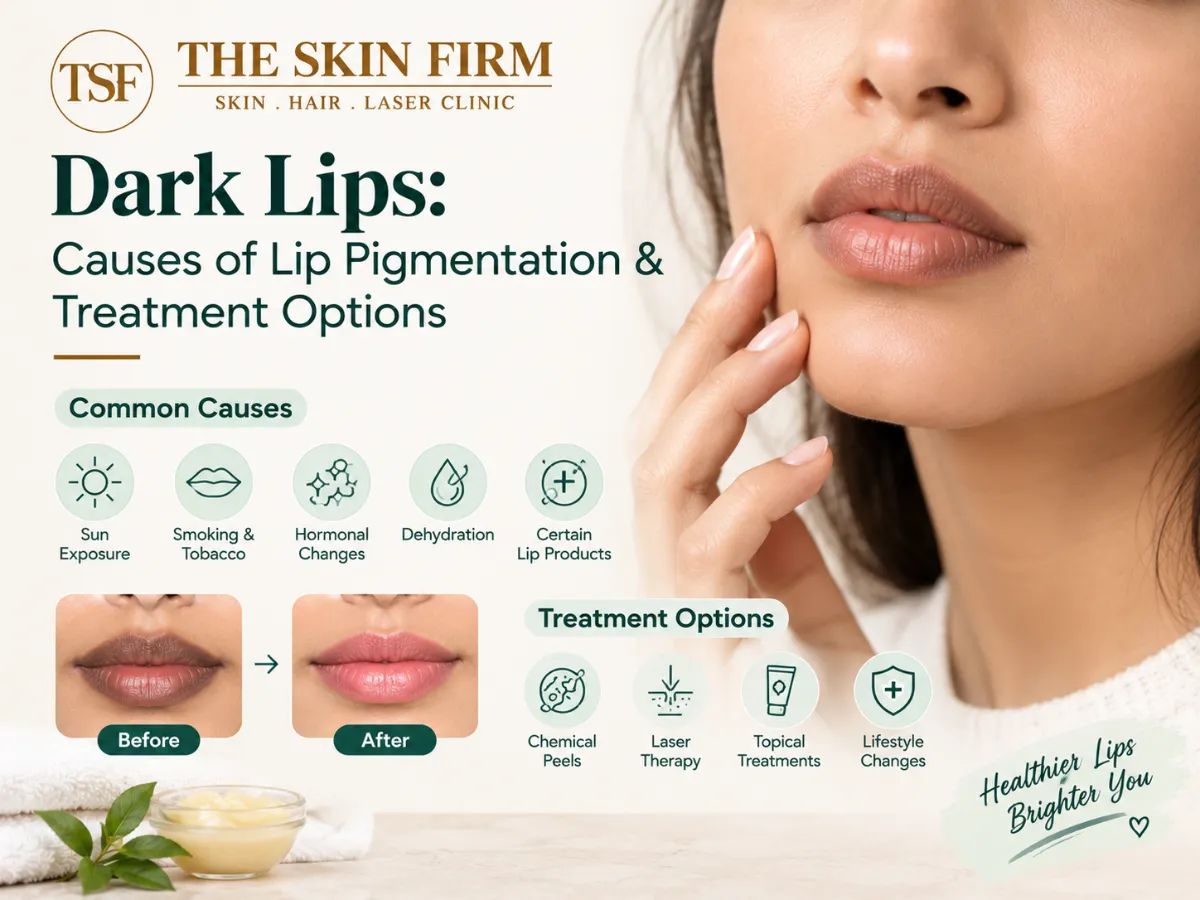
Lips usually turn dark because of sun exposure, smoking, frequent lip licking or dryness, allergies to lipstick or toothpaste, certain medicines, or pigment left behind after irritation. Some people simply have naturally darker lips. Protecting lips from the sun and removing the trigger is the first step. For persistent pigmentation, a doctor may suggest prescription creams, mild peels or a Q-switched laser.
Lip colour varies naturally from person to person, and darker lips are common and normal in Indian skin. But lips that have become darker over time, or that have patchy dark areas, often have a specific cause. This guide explains the common reasons, how to tell "on the lips" from "around the lips" pigmentation, what you can do at home and when treatments such as the Q-switch Nd:YAG laser are considered.
Is dark lip colour normal?
Yes, often. The amount of melanin in your lips is partly genetic, just like skin colour. Many people in India have naturally brown or dark lips, sometimes with a darker edge or a two-toned look between the upper and lower lip. Naturally pigmented lips don't need treatment.
It's worth looking for a cause if:
- Your lips have become darker over months or years
- The darkening is patchy or limited to one spot
- Dark patches come with dryness, peeling, itching or swelling
- A spot returns in the same place after taking a particular medicine
- A new dark spot appears that is changing in size, shape or colour
Common causes of dark lips
Sun exposure. Lips have a thin outer layer and little natural protection. Regular sun exposure without lip protection darkens them over time, particularly the lower lip, which faces the sun more.
Smoking and tobacco. Heat and chemicals in cigarettes, bidis and other tobacco stimulate pigment cells. This "smoker's melanosis" often affects the lips and gums. Stopping smoking is the most important step, and pigmentation tends to improve slowly afterwards.
Lip licking and chronic dryness. Licking dries the lips, and repeated dryness, cracking and peeling lead to inflammation. Inflammation in Indian skin often leaves dark marks.
Allergic or irritant reactions. Lipsticks, long-wear lip colours, flavoured lip balms and some toothpastes (especially strong mint or cinnamon flavours) can cause contact dermatitis. After the irritation settles, it may leave darker skin.
Fixed drug eruption. Some medicines, including certain painkillers and antibiotics, can cause a reaction that appears in the same spot each time you take them, often on the lips. It leaves a dark patch that deepens with each episode.
Other medicines. A few medicines, such as some antimalarials and certain antibiotics taken long term, can cause pigmentation of the lips and mouth.
Hormonal changes. Melasma, which is linked to hormones and sun, can darken the upper lip area.
Lip-related conditions. Long-standing cheilitis (inflamed, cracked lips) or eczema around the mouth often leaves pigment behind.
Rare medical causes. Conditions such as Addison's disease or inherited syndromes can cause dark spots on the lips and inside the mouth. These are uncommon but are a reason to see a doctor if pigmentation appears with tiredness, weight loss or spots inside the mouth.
Dark lips or darkness around the lips?
These are different problems with different causes.
- Typical causes: On the lips: Sun, smoking, lip licking, allergies, fixed drug eruption; Around the lips (perioral): Friction, threading or waxing, hair removal creams, eczema, melasma, acne marks
- Looks like: On the lips: Brown or bluish-dark lips, sometimes patchy; Around the lips (perioral): Dark ring or patches on the skin next to the lips, often at the corners or upper lip
- What helps: On the lips: Sun protection, stopping the trigger, lip-safe treatments; Around the lips (perioral): Gentle hair removal, treating dermatitis, sun protection, pigmentation treatments
Dark corners of the mouth can also come from saliva pooling at night, from angular cheilitis (cracking at the corners, sometimes with a yeast infection), or from nutritional deficiencies. A doctor can check which applies.
A single dark spot on the lip
A flat, brown spot on the lower lip is often a labial melanotic macule, a harmless freckle-like spot. However, any new spot that grows, has irregular edges or several colours, bleeds or doesn't heal should be examined promptly. Doctors use the same caution with lip spots as with moles elsewhere on the body.
What you can do at home
These steps help almost every type of lip pigmentation and prevent it from getting worse:
- 1. Use a lip balm with SPF 30 or higher every day, and reapply it after eating or drinking and every two hours outdoors
- 2. Stop licking your lips. Keep a plain balm with you and apply it whenever your lips feel dry
- 3. Moisturise at night with plain petroleum jelly or a fragrance-free lip balm
- 4. Stop smoking. It's the single most effective change for smoker's melanosis
- 5. Check your products. If darkening started after a new lipstick, balm or toothpaste, stop it for a few weeks and see whether the irritation settles
- 6. Note any medicines you were taking when a dark patch appeared and tell your doctor
- 7. Drink enough water and treat cracked lips early so they don't become inflamed
Home remedies to avoid
Online "pink lips" remedies often do more harm than good:
- Lemon juice is acidic and can burn delicate lip skin, particularly in sunlight
- Sugar scrubs used daily cause friction and inflammation
- Toothpaste irritates the lips and can cause allergic reactions
- Bleaching or fairness creams aren't designed for lips and can damage them
- Beetroot or other colouring remedies may tint the lips temporarily but don't change pigmentation
Gentle, occasional exfoliation with a soft cloth is fine if your lips are flaky. The goal is healthy lips, not a particular colour.
Clinic treatments for lip pigmentation
If pigmentation persists after removing the trigger, a doctor may suggest one or more of the following after examining you:
Prescription creams. Some depigmenting agents can be used carefully on the lips for short periods. Strength and duration must be set by a doctor, because lip skin is delicate and some agents cause irritation or uneven colour when misused.
Lip peels. Mild superficial peels, done by a doctor in a series, can lighten pigmentation caused by sun or inflammation. They aren't suitable if the lips are cracked, inflamed or prone to cold sores. Learn more on our chemical peel page.
Q-switched Nd:YAG laser. This laser targets pigment with very short pulses. Studies, including Indian research on lip melanosis, have reported improvement in many patients over several sessions. Possible side effects include temporary swelling, redness, crusting and, occasionally, uneven colour. Pigmentation can come back, particularly if smoking or sun exposure continues.
Treating the cause. If a medicine caused a fixed drug eruption, avoiding that medicine is essential. If eczema or cheilitis is present, it needs treatment first.
For most people, results are gradual and partial rather than complete. The aim is a more even, healthier lip colour, not a change to a different natural shade. A doctor will also check that a lip spot is harmless before treating it cosmetically.
What to expect from treatment
- How many sessions?: Peels and lasers usually need several sessions, a few weeks apart. Your doctor will estimate this after examination
- Downtime: Usually mild: some redness, swelling or flaking for a few days
- When do results show?: Gradually, over weeks after each session
- Will it come back?: It can, especially with smoking, sun exposure or continued lip licking
- Who should wait?: People with active cold sores, cracked or inflamed lips, or who are pregnant should discuss timing with their doctor
A daily lip routine for pigmented lips
- Morning: Rinse lips with water, apply a lip balm with SPF 30+, let it absorb before lipstick
- During the day: Reapply SPF balm after meals and every two hours outdoors; drink water regularly
- Before bed: Remove lipstick gently with a mild cleanser or oil, then apply a thick layer of petroleum jelly or plain balm
- Once a week (if flaky): Wipe gently with a soft, damp cloth after a shower. Skip it if lips are cracked
If you wear long-stay or matte lipsticks every day, consider alternating with a tinted balm. Matte formulas are often drying, and dryness leads to the licking-and-peeling cycle that darkens lips.
Can diet or deficiencies cause dark lips?
Nutrition is rarely the main cause of lip pigmentation, but deficiencies can make lips dry, cracked and inflamed, which then leaves dark marks. Low iron, vitamin B12 and other B vitamins are linked to cracking at the corners of the mouth and a sore, smooth tongue. If you have these symptoms, along with tiredness or pale skin, ask your doctor about blood tests rather than starting supplements on your own.
Preventing dark lips from coming back
Prevention is the same as the home care above, done consistently: a lip balm with SPF, no smoking, no lip licking, and avoiding products that irritate your lips. If you have had a fixed drug eruption, keep a note of the medicine's name and show it to every doctor and pharmacist you see.
When to see a doctor
See a doctor if:
- Your lips have darkened noticeably and you don't know why
- A dark patch keeps returning in the same place
- There's a single spot that is new, growing or changing
- Dark spots also appear inside your mouth or on your fingers
- Your lips are persistently cracked, swollen, itchy or peeling
- You have other symptoms such as tiredness, weight loss or dizziness
You can book a consultation at The Skin Firm, a skin, hair and laser clinic at NIBM Road, Pune, to have lip pigmentation assessed. For broader pigmentation concerns, see our pigmentation treatment page.
References
- Efficacy of 532-nm Q-switched Nd:YAG laser in the treatment of lip melanosis — Journal of Cutaneous and Aesthetic Surgery, 2021
- Efficacy and safety of Q-switched 532-nm Nd:YAG laser in lip hyperpigmentation: a pilot study — Journal of Clinical and Aesthetic Dermatology, 2021
- Labial melanotic macule — DermNet
- Fixed drug eruption — DermNet
- Effect of smoking on oral pigmentation — Dental Research Journal, 2012
This article is for general information and isn't a substitute for a medical consultation. Editorial note: drafted with AI assistance and medically reviewed before publication.