 Add as a preferred source on Google
Written by The Skin Firm clinical content team · Reviewed by Dr. Karishma Singh, BHMS, FCHD (Founder, Skin & Aesthetic Specialist) · Reviewed on 14 November 2026
Quick answer
Steroid creams used on the face without a doctor's advice can cause redness, burning, thin shiny skin, visible veins, acne-like bumps, a rosacea-like rash, extra facial hair and worsening fungal infections. When they are stopped, the skin often flares for a while. Recovery usually takes weeks to a few months, and some thinning may not fully reverse. See a doctor, who will plan how to stop safely.
In India, strong steroid creams have long been sold across the chemist's counter for acne, "fairness", melasma or an itchy rash. Many people in Pune only learn a cream contained a steroid when their face turns red and sensitive. Steroids are valuable medicines when prescribed, but not for experimenting on the face. This guide explains the signs, the Indian context and what recovery involves, and how a doctor at our skin clinic in Pune can help.
Why is steroid cream misuse so common in India?
Topical corticosteroids calm inflammation quickly. A pimple settles or an itch stops, so people keep applying.
Indian dermatologists have documented the problem for years. A review in the Indian Journal of Dermatology describes "topical steroid damaged/dependent face" (TSDF). It cites a 12-centre Indian study in which 14% of facial skin patients were using steroids on the face, and about 93% of that use was judged inappropriate.
A 2024 study of 100 patients with TSDF in northern India found:
- 63% bought the cream over the counter, and only 3% got it from a dermatologist
- The commonest reasons were acne (41%), melasma (20%) and a fairer complexion (12%)
- 72% were women, with an average age of about 28
- The molecules found were mometasone, clobetasol and betamethasone, among others
Combination creams add to the problem. Many mix a steroid with an antifungal and an antibiotic, or with lightening agents, and get used for acne, fungal rashes and dark spots alike. Our guide on skin whitening facts and myths explains why quick-lightening creams deserve suspicion.
What has India done about it?
The Indian Association of Dermatologists, Venereologists and Leprologists (IADVL) has campaigned against over-the-counter steroid sales for over a decade. It also set up a task force against topical steroid abuse.
In March 2018, the Health Ministry amended the Drugs and Cosmetics Rules to bring a further group of about 14 topical steroids under Schedule H. This means they should be sold only on a prescription. Dermatologists note that misuse for fairness continues, so reading labels still matters.
How can you tell if a cream contains a steroid?
You do not need brand names. Read the composition panel on the tube.
- 1. Look for an "Rx" symbol or a warning that the product is to be sold only on a doctor's prescription.
- 2. Scan the ingredient names. Most topical steroids end in -sone, -sol, -olone or -nide, or include "cort".
- 3. Common examples are clobetasol, betamethasone, mometasone, fluticasone, halobetasol, beclomethasone, fluocinolone, triamcinolone, desonide and hydrocortisone.
- 4. Check for a steroid listed alongside an antifungal (often ending in -azole) or an antibiotic. That is a combination cream.
- 5. If a "fairness" cream promises results within days, ask a doctor what it contains.
Not every steroid is equally strong. Clobetasol is among the most potent, while hydrocortisone is mild. Even mild steroids can cause problems if used on the face daily for months.
Prescribed use vs misuse: what is the difference?
- Who chooses it: Prescribed by a doctor: Doctor, after a diagnosis; Misused without advice: Chemist, friend, relative, social media
- Strength: Prescribed by a doctor: Lowest strength that works; Misused without advice: Often potent or super-potent
- Where applied: Prescribed by a doctor: Specific area, face only if needed; Misused without advice: Whole face, daily, as a "cream"
- Duration: Prescribed by a doctor: Short, defined course; Misused without advice: Weeks, months or years
- Stopping: Prescribed by a doctor: Planned, sometimes tapered; Misused without advice: Abrupt, or never stopped
- Follow-up: Prescribed by a doctor: Review of response and side effects; Misused without advice: None
What are the side effects of steroid cream on the face?
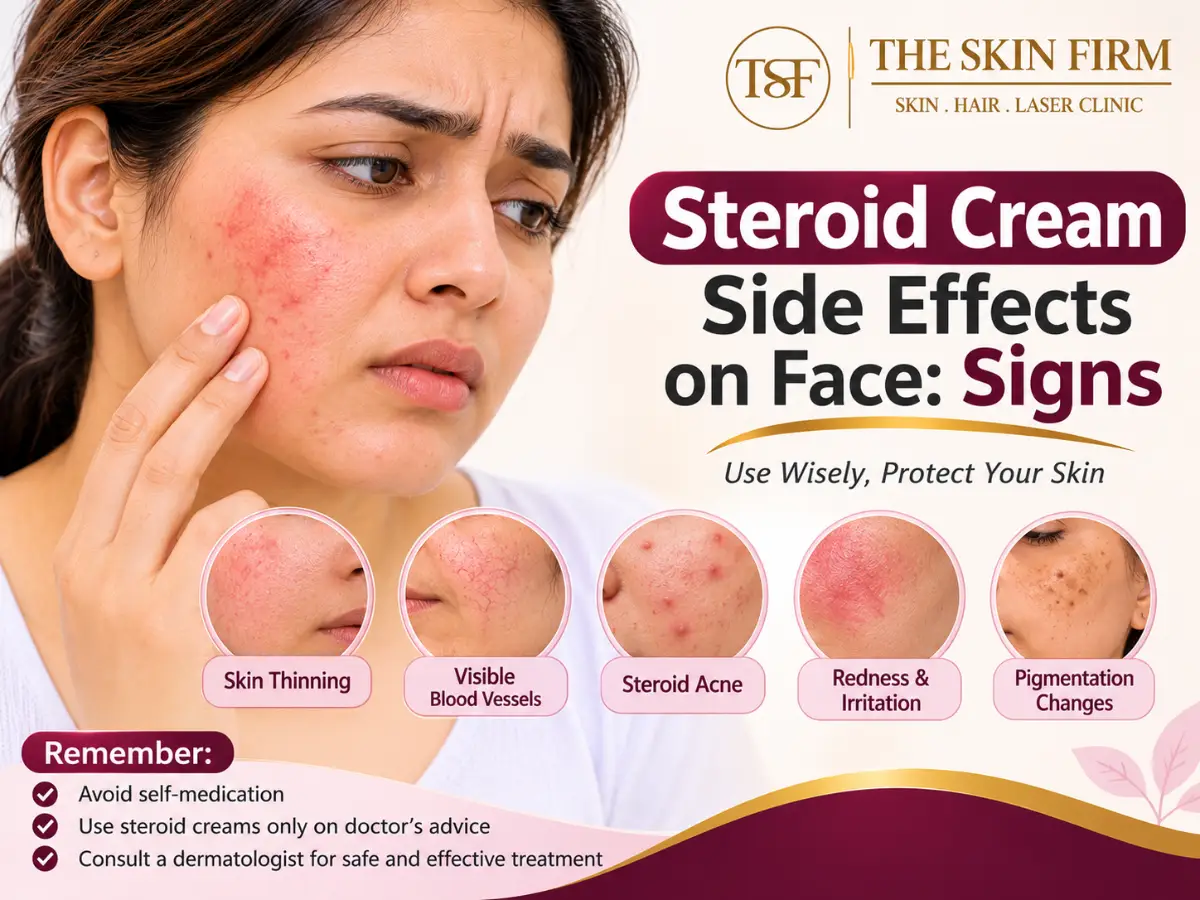
Facial skin is thin and absorbs steroids readily, so side effects appear sooner here than on the body. DermNet notes that daily use of a potent steroid for months can thin the skin, bring out visible vessels and cause extra hair.
- Redness and burning: Inflamed, steroid-dependent skin, the hallmark of TSDF
- Thin, shiny, fragile skin: Atrophy, where the skin layers have thinned
- Visible red lines: Telangiectasia, dilated small blood vessels
- Small uniform pimples: Steroid-induced acne or folliculitis
- Bumps around the mouth or nose: Perioral dermatitis
- Flushing, pustules on cheeks: Steroid-induced rosacea
- Darker or lighter patches: Pigment change, often worse with sun
- New fine hair on cheeks: Hypertrichosis
- Spreading rash with no clear edge: Tinea incognito, a fungal infection masked by the steroid
- Stretch marks: Striae, more likely in skin folds
On brown skin, redness may look darker, dusky or purplish rather than bright red. Many people also notice their face stings in the sun. In Pune's strong sunlight, this often adds to pigmentation. If your rash started as itchy ring-shaped patches, our article on fungal acne vs regular acne explains why steroids can make fungal problems worse.
What happens when you stop? Understanding the rebound
Many people find their skin worsens a few days after stopping. This is rebound, or topical steroid withdrawal (TSW). Indian authors describe redness for around two weeks followed by peeling. Flares can recur in cycles that gradually weaken.
The UK medicines regulator, the MHRA, issued advice on TSW in 2021. It noted that reactions most often follow long-term use of moderate or strong steroids on sensitive areas such as the face. Symptoms usually start within days to weeks of stopping. Burning, rather than itch, is a typical feature.
The evidence here is still evolving. There are no agreed diagnostic criteria, and no specific treatment has been clearly shown to shorten recovery. Severe reactions are thought to be uncommon.
Should you stop the cream suddenly?
The honest answer has two parts.
- Stop using unprescribed steroid creams on your face. Continuing only deepens dependence and damage.
- Do not manage the withdrawal alone. Doctors disagree on whether stopping at once or tapering is better. The right plan depends on the steroid's strength, how long you used it and how large an area is involved.
See a doctor, who will plan how to stop. If a steroid was prescribed for eczema or psoriasis elsewhere on the body, do not stop that without speaking to your prescriber. MHRA advice also says not to restart a steroid on your own if the skin worsens after stopping.
What will a doctor do?
A doctor first checks what you used, for how long, and whether there is an underlying condition. Treatment usually combines several steps:
- A stopping plan for the steroid, sometimes switching to a milder option briefly
- Non-steroid anti-inflammatory creams, such as tacrolimus or pimecrolimus, which may sting for the first few days
- Oral antibiotics from the tetracycline group for rosacea-like or perioral eruptions, which can cause stomach upset and sun sensitivity
- Antihistamines for itch, and antifungals if tinea is found
- Treating the original problem properly, such as acne, melasma or eczema
These are prescription medicines with their own risks. Please do not self-medicate with any of them.
Once the skin has settled, which may take several months, a doctor may discuss pigmentation and melasma treatment for leftover dark patches. Peels and lasers are generally avoided while the skin is still inflamed.
How long does recovery take?
Recovery is gradual. DermNet reports that most people with steroid withdrawal improve within about three months, while a small number take much longer.
- Burning and redness: usually ease over several weeks to a few months, with flares in between
- Acne-like bumps and perioral rash: often settle over weeks with treatment
- Pigmentation: fades slowly over months, if you protect your skin from the sun
- Thinning and visible vessels: improve slowly, and may not fully reverse
Results vary from person to person.
A gentle routine while your skin recovers
- Wash with plain lukewarm or cool water, or a mild soap-free cleanser
- Use a simple, fragrance-free moisturiser, or plain petroleum jelly if creams sting
- Use cool compresses for burning
- Apply a mineral sunscreen, and use an umbrella or cap outdoors
- Pause acids, scrubs, retinoids, bleach, facials and new actives
- Avoid lemon, turmeric packs or toothpaste on inflamed skin
Salon treatments can aggravate steroid-damaged skin. Read why a doctor rather than a salon matters for problems like this.
When should you see a doctor?
See a doctor if you have used any steroid or combination cream on your face for more than two weeks. Go sooner if you notice burning, spreading redness, pus-filled bumps, swelling or a rash near the eyes. Long use around the eyes may raise the risk of glaucoma and cataracts, so eye symptoms need prompt attention.
You can book a consultation at The Skin Firm, a skin, hair and laser clinic at NIBM Road, Pune, to have your skin assessed and a stopping and recovery plan made for you.
References
- Topical Steroid Damaged/Dependent Face (TSDF): An Entity of Cutaneous Pharmacodependence — Indian Journal of Dermatology (via PMC)
- A Descriptive Study of Patients Presenting With Topical Steroid Damaged/Dependent Face (TSDF) to a Tertiary Care Center in Northern India — Cureus (via PMC)
- Topical steroid — DermNet
- Topical corticosteroid withdrawal — DermNet
- Topical corticosteroids: information on the risk of topical steroid withdrawal reactions — MHRA, GOV.UK
This article is for general information and isn't a substitute for a medical consultation. Editorial note: drafted with AI assistance and medically reviewed before publication.