 Add as a preferred source on Google
Written by The Skin Firm clinical content team · Reviewed by Dr. Karishma Singh, BHMS, FCHD (Founder, Skin & Aesthetic Specialist) · Reviewed on 24 November 2026
Quick answer
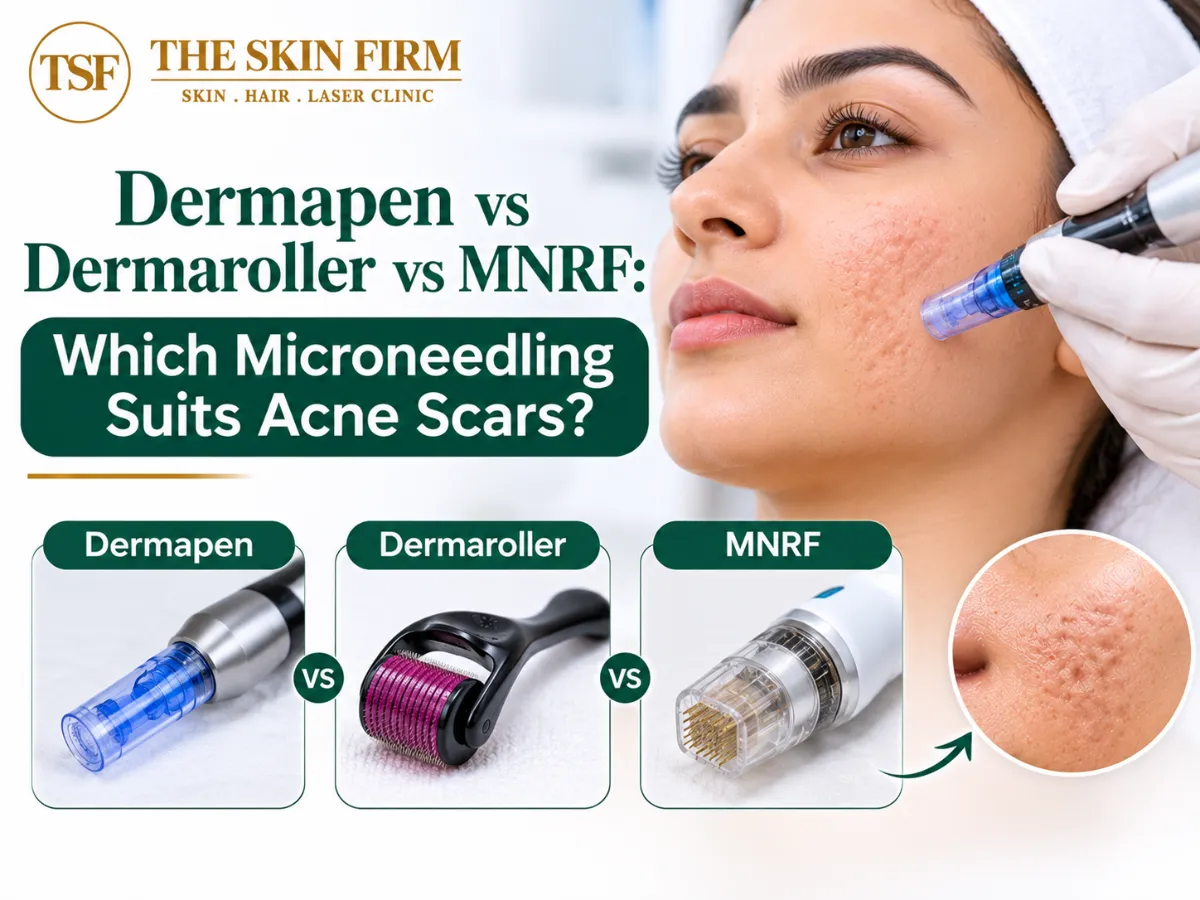
All three make tiny controlled injuries in the skin to trigger new collagen, which softens acne scars. A dermaroller is a hand-rolled drum of fixed needles; a dermapen is a motorised pen that stamps needles straight in at an adjustable depth, which gives more even treatment; MNRF (microneedling radiofrequency) adds heat at the needle tips for deeper remodelling. In a 2024 Indian study, MNRF gave results similar to fractional CO2 laser for acne scars, with next-day return to work and no dark patches. Home rollers are shallow, hard to keep sterile and can cause infection and pigmentation.
How microneedling works
Microneedling (also called collagen induction therapy) uses fine needles to make many tiny channels in the skin. The skin repairs these channels by laying down new collagen and elastin, which gradually lifts depressed scars and smooths texture.
A 2016 review in the Indian Dermatology Online Journal describes microneedling as a simple, minimally invasive technique used for acne scars, other scars, stretch marks, hair loss and skin rejuvenation. It also notes that microneedling is a safe option for dark skin, because it damages the surface layer less than many lasers and peels, so the risk of dark patches is lower.
Dermaroller vs dermapen vs MNRF at a glance
- How it works: Dermaroller: Drum of fixed needles rolled across the skin; Dermapen (motorised pen): Needle cartridge that stamps vertically at high speed; MNRF (RF microneedling): Insulated needles that release radiofrequency heat at the tip
- Depth control: Dermaroller: Fixed by the needle length; pressure varies; Dermapen (motorised pen): Adjustable, area by area; MNRF (RF microneedling): Adjustable depth and energy
- Evenness: Dermaroller: Needles enter at an angle; harder to treat evenly; Dermapen (motorised pen): More even; reaches around the nose and eyes; MNRF (RF microneedling): Even; treats deeper layers
- Main use: Dermaroller: Mild texture and shallow scars; Dermapen (motorised pen): Acne scars, open pores, texture; MNRF (RF microneedling): Moderate to deep acne scars, pores, skin laxity
- Typical downtime: Dermaroller: 1–3 days of redness; Dermapen (motorised pen): 1–3 days of redness; MNRF (RF microneedling): Redness and mild swelling; often back to work the next day
- Comfort: Dermaroller: Numbing cream used; Dermapen (motorised pen): Numbing cream used; MNRF (RF microneedling): Numbing cream used; warmer feeling
- Pigment risk in brown skin: Dermaroller: Low when done correctly; Dermapen (motorised pen): Low when done correctly; MNRF (RF microneedling): Low; heat is delivered below the surface
Dermapen vs dermaroller: which is better for acne scars?
Both work on the same principle, but a dermapen gives a doctor more control. Because the needles go straight in rather than rolling at an angle, the depth is more even and there is less dragging of the skin. The depth can be changed for each area, deeper over scars on the cheeks and shallower over the forehead or near the eyes.
Dermarollers are still used in clinics, but for acne scars most doctors now prefer a pen device or MNRF.
What MNRF adds
MNRF combines microneedling with radiofrequency energy. The needles are insulated along their length, so the heat is released only at the tips, deep in the skin. This heats the layer where collagen is made while leaving most of the surface untouched.
A 2024 retrospective study from Bengaluru, published in the Journal of Cutaneous and Aesthetic Surgery, compared MNRF with fractional CO2 laser in 32 patients with moderate to severe acne scars (skin types III and IV):
- Results: Both groups improved significantly over four sessions spaced four to six weeks apart, with no significant difference between them.
- Scar types: Rolling and boxcar scars improved more than deep, narrow ice-pick scars.
- Dark patches: Two of 16 patients in the CO2 group developed post-inflammatory hyperpigmentation; none in the MNRF group did.
- Downtime: CO2 patients had about five days of downtime; MNRF patients could return to work the next day.
The study was small and looked back at past records, so it isn't the final word. But it supports MNRF as a reasonable option for brown skin. If you're comparing it with laser, our guide to CO2 laser recovery and aftercare explains what laser downtime involves.
Which option suits which scar
- Mild texture, enlarged pores: Usual starting option: Dermapen microneedling
- Rolling scars (wavy, shallow): Usual starting option: Dermapen or MNRF, sometimes with subcision
- Boxcar scars (flat-bottomed): Usual starting option: MNRF or fractional laser
- Ice-pick scars (deep, narrow): Usual starting option: Often need targeted methods (such as TCA CROSS) plus microneedling or laser
- Dark marks after acne, no dip in the skin: Usual starting option: Usually creams, peels or toning rather than microneedling
If your marks are flat and brown rather than dented, they may be marks, not scars. Our guide to acne marks vs acne scars explains the difference.
Microneedling with PRP
Some clinics combine microneedling with platelet-rich plasma (PRP), made from your own blood, applied during or after the session. The idea is that growth factors in PRP support healing and collagen. It adds time and a blood draw to the session. Ask your doctor whether it is likely to add enough for your scar type.
Why home dermarollers are risky
Home rollers are widely sold, but a 2026 Dermatology Times review of the evidence raised several concerns:
- They are shallow. Most home rollers reach about 0.2–0.5 mm, while clinical studies used depths of about 0.5–3.0 mm under controlled conditions. Shallow rollers can exfoliate but are unlikely to remodel scars.
- They are hard to keep sterile. Rollers are often reused and sometimes shared, and rinsing with water does not clean the needles. The review cites a serious skin infection that needed months of antibiotics.
- Uneven pressure can cause irritation, breakouts and dark patches.
- No home microneedling device has been cleared by the US FDA; cleared devices are for trained practitioners.
Never use a roller over active acne, cold sores, eczema or broken skin.
What to expect: sessions, downtime and results
- Sessions: acne scars usually need a series of sessions, often four to six, spaced about four to six weeks apart. See how many sessions acne scar treatment takes for how scar type changes this.
- Downtime: redness like a mild sunburn for one to three days; some swelling after MNRF. Most people return to work within a day or two.
- Results: skin looks smoother over the weeks after each session as collagen forms, and keeps improving for a few months after the last one. Scars soften rather than disappear, and results vary.
- Aftercare: gentle cleansing, a plain moisturiser, strict sunscreen, and no actives, makeup, gym or swimming for the time your doctor advises.
What a first session feels like is covered in your first microneedling session.
Who should wait
Microneedling is usually postponed if you have active acne or infection, a cold sore, a fresh tan, eczema on the face, or a tendency to keloids. Tell your doctor about blood thinners, isotretinoin, diabetes and pregnancy.
Microneedling at The Skin Firm, Pune
At The Skin Firm, the doctor first checks your scar types and skin type, then explains which method is likely to suit you, how many sessions to expect, and how microneedling fits with other acne scar treatments.
Learn more about microneedling in Pune or book a consultation.
References
- Singh A, Yadav S. Microneedling: advances and widening horizons. Indian Dermatology Online Journal. 2016;7(4):244–254.
- Sriram R, Chandrashekar BS, Madura C, Gowda HH. Comparative study in treatment of acne scars: fractional carbon dioxide laser versus microneedling fractional radiofrequency. Journal of Cutaneous and Aesthetic Surgery. 2024;17(3):214–218.
- Bosslett M. Social media mythbusters: at-home dermarollers. Dermatology Times. 2026.
This article is for general information and isn't a substitute for a medical consultation. Editorial note: drafted with AI assistance and medically reviewed before publication.