
 Add as a preferred source on Google
Written by The Skin Firm clinical content team · Reviewed by Dr. Karishma Singh, BHMS, FCHD (Founder, Skin & Aesthetic Specialist) · Reviewed on 16 October 2026
Quick answer
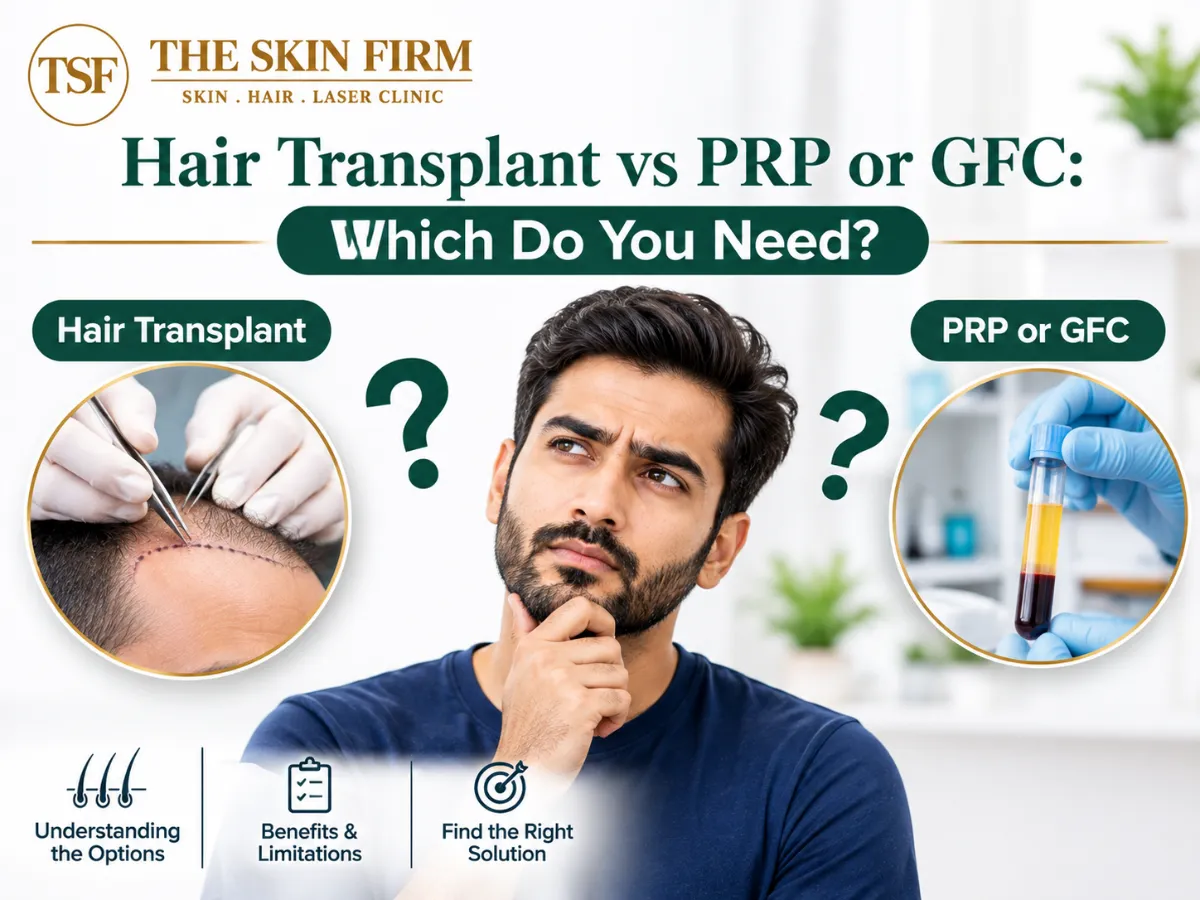
PRP and GFC are most useful in early to moderate hair thinning, where follicles are still alive but miniaturising. They can improve hair density and slow loss, usually alongside medicines such as minoxidil. A hair transplant moves healthy follicles from the back of the scalp to bald areas, so it suits people with established bald patches, stable hair loss and enough donor hair. Many people who have a transplant still need medical treatment, and sometimes PRP or GFC, to protect the hair they still have.
If you're losing hair, you've probably been told two different things: that a transplant is the only real solution, or that PRP or GFC will grow your hair back. The truth depends on your stage of hair loss, your age, your donor hair and what you expect. This guide explains each option, who it suits and how to decide. The Skin Firm offers non-surgical hair treatments such as GFC therapy. If a transplant looks like a better fit for you, our doctor will tell you so.
First, what kind of hair loss do you have?
Transplants, PRP and GFC are mainly used for androgenetic alopecia, also called male or female pattern hair loss. It's caused by genetics and the effect of hormones on hair follicles, which gradually shrink (miniaturise) and produce thinner, shorter hairs until some stop growing altogether.
Other types of hair loss, such as hair fall after illness (telogen effluvium), patchy alopecia areata or hair loss from deficiencies, need different treatment. A transplant or PRP isn't the answer for those. If your hair fall started after a fever, for example, read our guide to hair fall after dengue, typhoid or fever.
Stages of pattern hair loss
Doctors use scales to describe how advanced pattern hair loss is:
- Men: the Norwood scale (stages I–VII). Early stages show slight recession at the temples. Middle stages show deeper temple recession and thinning at the crown. Later stages show a large bald area across the top with a horseshoe of hair at the sides and back
- Women: the Ludwig scale (stages I–III). Women usually keep their hairline but notice a widening parting and thinning over the top of the scalp
What PRP and GFC do
PRP (platelet-rich plasma) is made from a small sample of your own blood. It's spun in a centrifuge to concentrate the platelets, which carry growth factors, and then injected into the thinning areas of the scalp.
GFC (growth factor concentrate) is a related treatment that uses a different process to concentrate growth factors from your blood. The aim is the same: to support follicles that are weakening.
What the evidence shows:
- Reviews of PRP in androgenetic alopecia, including one in the Indian Journal of Dermatology, report improvements in hair density and thickness in many patients, though results vary between studies and individuals
- PRP and GFC can't create new follicles where they're completely lost. They work on follicles that are still alive
- Several sessions are needed, usually 3–6 spaced about a month apart, followed by maintenance sessions every few months
- Results tend to be better when combined with medical treatment such as minoxidil, and, for suitable men, oral medicines prescribed by a doctor
Possible side effects are usually mild: tenderness, swelling or a headache for a day or two, and small bruises at injection sites. You can read a detailed comparison in our post on GFC therapy vs PRP for hair regrowth.
Other non-surgical options include peptide-based treatments such as QR678, which are also used to support thinning hair, usually as part of a combined plan.
Medicines: the foundation of most hair loss plans
Whether you choose PRP, GFC, a transplant or none of these, medical treatment is usually the starting point for pattern hair loss.
- Minoxidil (applied to the scalp, and in some cases taken as low-dose tablets under medical supervision) prolongs the growth phase of hair. It takes 3–6 months to show results, and hair gained usually depends on continuing it. Initial shedding in the first weeks is common and usually temporary
- Finasteride (for men, prescribed by a doctor) reduces the hormone that shrinks follicles. It can slow or stop progression in many men. Possible side effects should be discussed with your doctor before starting
- Other options for women, such as certain hormonal medicines, may be considered when hair loss is linked to hormones, for example with PCOS
These medicines need a prescription and follow-up, because the right choice depends on your age, sex, health and plans for pregnancy. Don't start them based on online advice. Our post on PRP vs minoxidil for hair loss compares the two in more detail.
What a hair transplant does
A hair transplant is a surgical procedure. Follicles are taken from the donor area, usually the back and sides of the head, where hair is genetically resistant to pattern loss. They're implanted into thinning or bald areas.
The two main techniques are:
- FUE (follicular unit extraction): individual follicles are removed one by one
- FUT (follicular unit transplantation): a strip of scalp is removed from the donor area and divided into follicles
Transplanted hair usually keeps growing long term, because it keeps the resistance of the donor area. The final result takes about 9–12 months to show. The American Academy of Dermatology notes that good candidates have enough healthy donor hair and realistic expectations.
What a transplant doesn't do is stop the rest of your native hair from thinning. Without medical treatment, surrounding hair can continue to thin, which can leave patchy results over time. That's why most transplant surgeons recommend ongoing medical treatment afterwards.
Which option suits which stage?
- Early thinning (Norwood I–II, Ludwig I): Non-surgical (medicines, PRP, GFC): Usually the first choice; Hair transplant: Usually not needed yet
- Moderate loss with some bald areas (Norwood III–IV): Non-surgical (medicines, PRP, GFC): Can slow loss and improve density; Hair transplant: May be considered for receding temples or hairline if loss is stable
- Advanced loss (Norwood V–VII): Non-surgical (medicines, PRP, GFC): Helps protect remaining hair; Hair transplant: Often the main option if donor hair is enough
- Women with diffuse thinning (Ludwig I–II): Non-surgical (medicines, PRP, GFC): Usually first choice; Hair transplant: Rarely suitable, because donor hair may also be thinning
- Under 25 with rapidly progressing loss: Non-surgical (medicines, PRP, GFC): Usually advised first to stabilise loss; Hair transplant: Often postponed; future loss is hard to predict
- Weak or thin donor area: Non-surgical (medicines, PRP, GFC): Main option; Hair transplant: Limited or not suitable
This is a general guide. Indian hair transplant practice guidelines stress careful assessment of age, stage, donor area and the likely pattern of future loss before surgery.
Time, cost and recovery compared
- Type: PRP or GFC: Non-surgical injections; Hair transplant: Surgery under local anaesthesia
- Time per session: PRP or GFC: About 45–90 minutes; Hair transplant: Usually a full day
- Number of sessions: PRP or GFC: A course of 3–6, then maintenance; Hair transplant: Usually one procedure; some people need a second
- Recovery: PRP or GFC: Back to normal the same or next day; Hair transplant: Scabbing and redness for 1–2 weeks; shedding of transplanted hair is expected before regrowth
- When results show: PRP or GFC: Gradually over 3–6 months; Hair transplant: 9–12 months for the full result
- Ongoing treatment: PRP or GFC: Maintenance sessions; Hair transplant: Medical treatment usually advised to protect native hair
- Overall cost: PRP or GFC: Spread over time; Hair transplant: Higher one-time cost
Costs depend on the extent of hair loss and the treatment plan, so a doctor can only estimate them after examining you.
Can you combine them?
Yes, and many people do. Common combinations include:
- Medicines plus PRP or GFC for early to moderate thinning
- PRP or GFC before a transplant to strengthen thinning native hair
- PRP or GFC after a transplant, which some surgeons use to support healing and the surrounding hair
- Medicines after a transplant to slow ongoing loss
How to decide: questions to ask at your consultation
- 1. What type of hair loss do I have, and what stage is it?
- 2. Is my hair loss still progressing, or has it stabilised?
- 3. Would medicines alone help, and for how long would I need them?
- 4. What results are realistic for me with PRP or GFC, and how many sessions?
- 5. Is my donor area strong enough for a transplant now or later?
- 6. What happens to my native hair if I have a transplant but no medical treatment?
- 7. What are the side effects and recovery time for each option?
If you're considering a transplant, choose a qualified surgeon who examines you personally, explains the plan and is involved in the procedure. Indian practice guidelines emphasise that key steps of the surgery should be performed or supervised by the doctor.
Myths about hair transplants and PRP
"A transplant means I never need treatment again." Transplanted hair lasts, but native hair can keep thinning. Ongoing medical treatment is usually advised.
"PRP regrows hair on a completely bald scalp." PRP can't create new follicles. It can only help thinning areas where follicles are still alive.
"Women can't have transplants." Some can, particularly with a stable, localised pattern and a strong donor area, but many women with diffuse thinning do better with medical treatment.
"Younger is better for a transplant." Very young patients often have hair loss that is still progressing, which makes long-term planning harder.
Getting your hair loss assessed in Pune
A scalp examination, sometimes with trichoscopy, shows how many follicles are miniaturising, how strong the donor area is and which treatment suits your stage. You can book a consultation at The Skin Firm, a skin, hair and laser clinic at NIBM Road, Pune. To learn about our non-surgical approach, see our hair density and regrowth page.
References
- Hair transplants: who is a good candidate — American Academy of Dermatology
- Male pattern hair loss: can it be treated? — American Academy of Dermatology
- Platelet-rich plasma therapy for androgenetic alopecia — Indian Journal of Dermatology, 2019
- Hair transplant practice guidelines — Journal of Cutaneous and Aesthetic Surgery, 2021
- Systematic review of PRP in androgenetic alopecia compared with minoxidil, finasteride and stem-cell therapy — International Journal of Molecular Sciences, 2020
This article is for general information and isn't a substitute for a medical consultation. Editorial note: drafted with AI assistance and medically reviewed before publication.