 Add as a preferred source on Google
Written by The Skin Firm clinical content team · Reviewed by Dr. Karishma Singh, BHMS, FCHD (Founder, Skin & Aesthetic Specialist) · Reviewed on 9 November 2026
Quick answer
Eczema often gets worse in winter because cool, dry air pulls water out of skin whose barrier is already weak. Hot baths, woollens and frequent hand-washing add to the damage. Eczema treatment rests on daily moisturising, gentle washing and avoiding triggers, plus prescription creams during flares. There is no cure, but many adults can keep it well controlled with a doctor's plan.
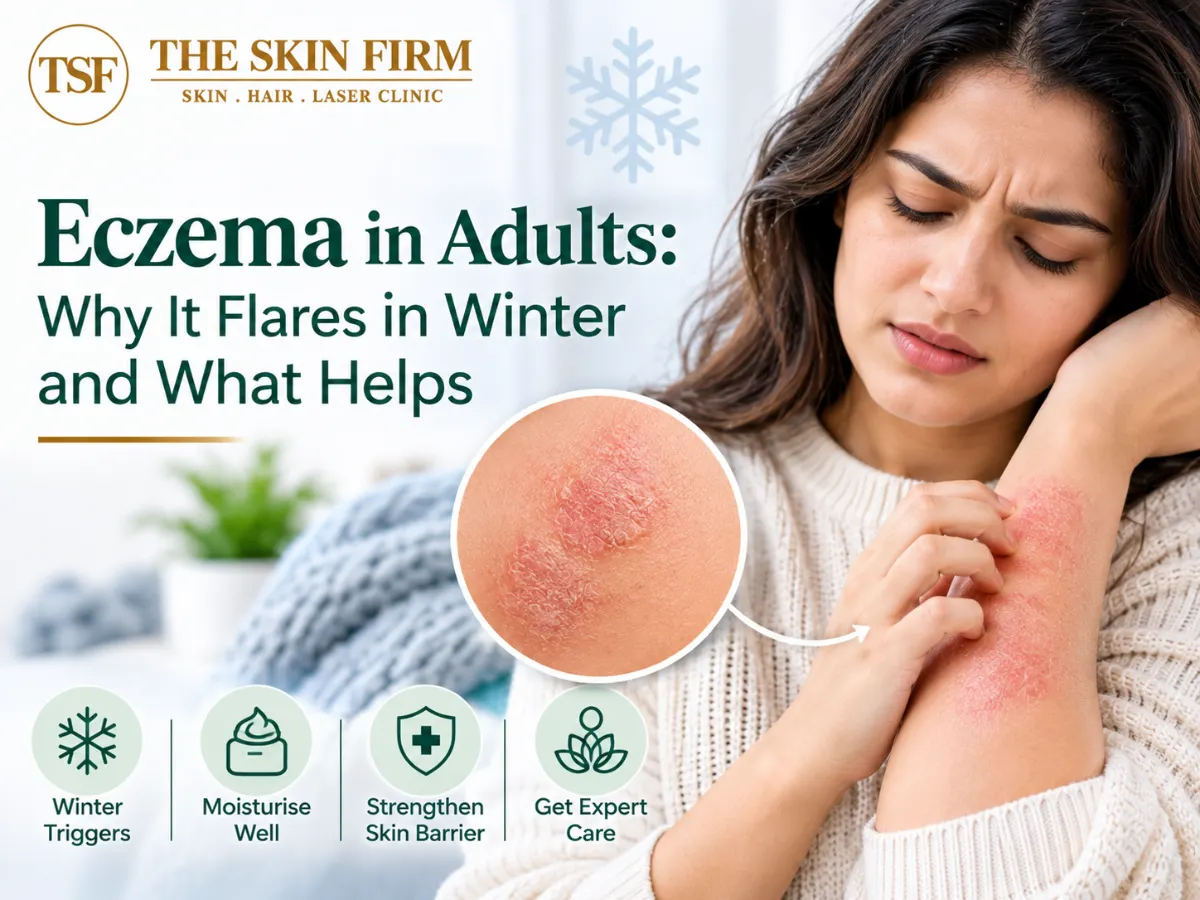
Every November, Pune's mornings turn crisp and the air dries out. For many adults, that is when itchy, rough patches return on the hands, elbows, neck or face. This guide explains why winter sets eczema off, how it looks on Indian skin and which treatments doctors use. Our skin treatments page explains how a consultation works.
What is atopic dermatitis (eczema)?
Atopic dermatitis, also called atopic eczema, is a long-term inflammatory skin condition. It causes dry skin, intense itch and a rash that comes and goes in flares.
The root problem is a leaky skin barrier combined with an over-reactive immune response. Genes play a part, so eczema often runs in families alongside asthma or hay fever. It is not contagious.
Doctors usually diagnose it by examining the skin and asking about your history. Patch testing may be suggested if an allergy to something you touch is suspected.
Can you get eczema for the first time as an adult?
Yes. Some people had eczema as children and see it return in their twenties or later. Others develop it for the first time in adulthood, called adult-onset eczema.
Adult eczema often looks different from childhood eczema:
- Thick, leathery patches on the neck, wrists or ankles from long-term scratching
- Coin-shaped (discoid) patches on the arms or legs
- Itchy eyelids and skin around the eyes
- Hand eczema, one of the most common adult patterns
Hand eczema and wet work. Water, soap, detergents, cleaning liquids and friction strip natural oils from the skin. Repeated small exposures add up over weeks.
In Indian homes, this hits homemakers hardest. Washing utensils, hand-washing clothes, and handling lemon, onion and garlic expose the hands to irritants many times a day. Healthcare workers, cooks, cleaners and hairdressers face the same problem from frequent washing and sanitiser use.
Why does eczema get worse in winter?
Pune's winter, roughly November to February, brings cool mornings, chilly nights and dry air. Eczema-prone skin already loses water too easily, so it dries out and cracks faster.
Several winter habits make things worse:
- Hot-water baths: Why it hurts eczema skin: Strip the skin's natural oils; Easier swap: Lukewarm water, under 10 minutes
- Woollen sweaters and shawls: Why it hurts eczema skin: Rough fibres scratch and irritate; Easier swap: A soft cotton layer underneath
- Harsh bathing soap: Why it hurts eczema skin: Removes the protective lipid layer; Easier swap: A mild, soap-free cleanser
- Skipping moisturiser because it "feels cold": Why it hurts eczema skin: Barrier repair stops; Easier swap: Apply after every bath
- Long hours in air-conditioned offices: Why it hurts eczema skin: Indoor air dries skin further; Easier swap: Moisturise again midday
Festive cleaning and stress can also tip skin into a flare. For a fuller routine, read our guide to a winter skincare routine for dry skin and barrier repair.
How does eczema look on brown skin?
Textbook pictures show eczema as bright red. On Indian brown skin, it often does not look red at all, so it gets brushed off as "just dryness".
On brown skin, active eczema may appear:
- Dark brown, purple or ash-grey rather than red
- Dry and scaly, sometimes with tiny bumps around hair follicles
- Thick and leathery, with exaggerated skin lines where scratched for months
Because redness is harder to see, eczema on darker skin can be more severe than it looks.
After a flare settles, many people are left with dark patches (post-inflammatory hyperpigmentation) or, less often, lighter patches. These are not scars. They usually fade slowly over months once eczema stays controlled. Scrubbing or bleaching only irritates the skin further. Read more on the causes of skin pigmentation and treatment.
Is it eczema, ringworm or psoriasis?
These three are often confused in India, and the wrong cream can make each one worse. This is a rough guide; only an examination can confirm which one you have.
- Itch: Eczema: Intense, often worse at night; Ringworm (fungal infection): Itchy, especially in sweaty areas; Psoriasis: Mild to moderate, sometimes none
- Shape: Eczema: Ill-defined dry patches; Ringworm (fungal infection): Rings with a raised active edge; Psoriasis: Well-defined, thick plaques
- Scale: Eczema: Fine, dry; may ooze when acute; Ringworm (fungal infection): Mostly at the edge; Psoriasis: Thick, silvery-white
- Common sites: Eczema: Hands, elbow and knee folds, neck, eyelids; Ringworm (fungal infection): Groin, waist, under the breasts, thighs; Psoriasis: Elbows, knees, scalp, lower back, nails
- Spreads to others?: Eczema: No; Ringworm (fungal infection): Yes, by contact and shared towels; Psoriasis: No
- Main treatment: Eczema: Moisturisers, anti-inflammatory creams; Ringworm (fungal infection): Antifungal medicines; Psoriasis: Prescription creams, phototherapy, tablets
If a patch keeps spreading in rings, or came back bigger after a steroid cream, see a doctor before trying anything else.
Daily care that calms eczema
Good daily care does more for long-term control than any single cream. Moisturisers (emollients) are the foundation, and you need them even when skin looks fine.
Try the "soak and smear" routine once a day in winter:
- 1. Bathe in lukewarm water for 5 to 10 minutes.
- 2. Use a gentle, fragrance-free, soap-free cleanser only where needed.
- 3. Pat the skin almost dry with a soft cotton towel.
- 4. Within a few minutes, while skin is still damp, apply a thick moisturiser all over.
- 5. Reapply at least twice a day, and after every hand-wash.
A few more habits help:
- Choose plain, unperfumed creams or ointments; thicker ones suit winter.
- Wear loose cotton next to the skin and give laundry an extra rinse.
- Keep nails short to limit damage from night-time scratching.
For hands: Wear rubber or vinyl gloves with cotton liners for washing up and laundry. Take them off once the task is done, since trapped sweat also irritates. Keep a moisturiser by the sink.
For the face: Facial skin is thin. Avoid scrubs, alcohol toners and perfumed products. Never apply a steroid cream to the face unless a doctor has said which one and for how long. Our tips on skin care for Pune's climate and pollution also help.
What treatments do doctors use for eczema?
Eczema treatment is matched to severity, body area and age. Please do not self-medicate with any of the medicines below.
Topical steroids, used correctly. These remain the main treatment for flares. A doctor picks the strength for each area: milder ones for the face and folds, stronger ones for the palms. Used for the right length of time, they work well. Overuse can thin the skin.
Topical calcineurin inhibitors. Tacrolimus and pimecrolimus are non-steroid creams that calm inflammation. They are often used on the face, eyelids and folds, or to reduce steroid use. They can sting at first.
Phototherapy. Indian dermatology guidance describes narrowband UVB as a second-line option for adults not controlled with creams. It usually means sessions a few times a week over several weeks. Side effects can include dryness, burning and darkening of brown skin.
Treatments for severe eczema. When eczema is widespread or disrupts sleep and work, a doctor may consider immune-calming tablets. Newer options include injectable biologic medicines and tablets called JAK inhibitors. All need careful selection and regular monitoring.
Antibiotics or antivirals are added only if the skin becomes infected.
Why mixed creams from the chemist can backfire
Many people buy combination creams over the counter that mix a strong steroid with an antifungal and an antibiotic. In a North Indian study of dermatology outpatients, close to a third of new patients had misused topical steroids.
These creams can thin the skin, cause rebound flares and disguise fungal infections. If you use one, do not stop abruptly without advice; bring the tube to your appointment. We cover this in a separate post.
Does eczema ever go away?
There is no cure for atopic eczema yet. Many children outgrow it, but sensitive skin often stays. Adults usually see long calm spells, then flares with triggers such as winter, stress or wet work.
The realistic goal is control: fewer, shorter flares and comfortable skin between them. Results vary, and consistent care may take a few weeks to show a change.
Signs your eczema may be infected
Scratched skin lets bacteria and viruses in. Seek medical help promptly if you notice:
- Yellow crusts, weeping fluid or pus-filled spots
- Pain, swelling or warmth in a patch
- Eczema that suddenly worsens or spreads fast
- Clusters of small, painful, punched-out sores
- Fever or feeling generally unwell
Painful clustered sores can signal eczema herpeticum, a viral infection that needs same-day care.
When to see a doctor
See a doctor if:
- Moisturisers and gentle care have not helped within two to three weeks
- Itch is keeping you awake or affecting work
- Your hands are cracking or bleeding
- You are unsure whether it is eczema, ringworm or psoriasis
- You have used a steroid or mixed cream for weeks
You can book a consultation at The Skin Firm, a skin, hair and laser clinic at NIBM Road, Pune. A doctor there can examine your skin, confirm the diagnosis and plan winter care that fits your routine.
References
- Atopic eczema — NHS
- Atopic dermatitis (atopic eczema) — DermNet
- Hand dermatitis (hand eczema) — DermNet
- Phototherapy for atopic dermatitis — Indian Journal of Dermatology, Venereology and Leprology (IADVL)
- Magnitude, characteristics and consequences of topical steroid misuse in rural North India — BMJ Open
This article is for general information and isn't a substitute for a medical consultation. Editorial note: drafted with AI assistance and medically reviewed before publication.