
 Add as a preferred source on Google
Written by The Skin Firm clinical content team · Medically reviewed by Dr. Monica C., MD (Dermatology, Venereology & Leprosy) · Reviewed on 16 October 2026
Quick answer
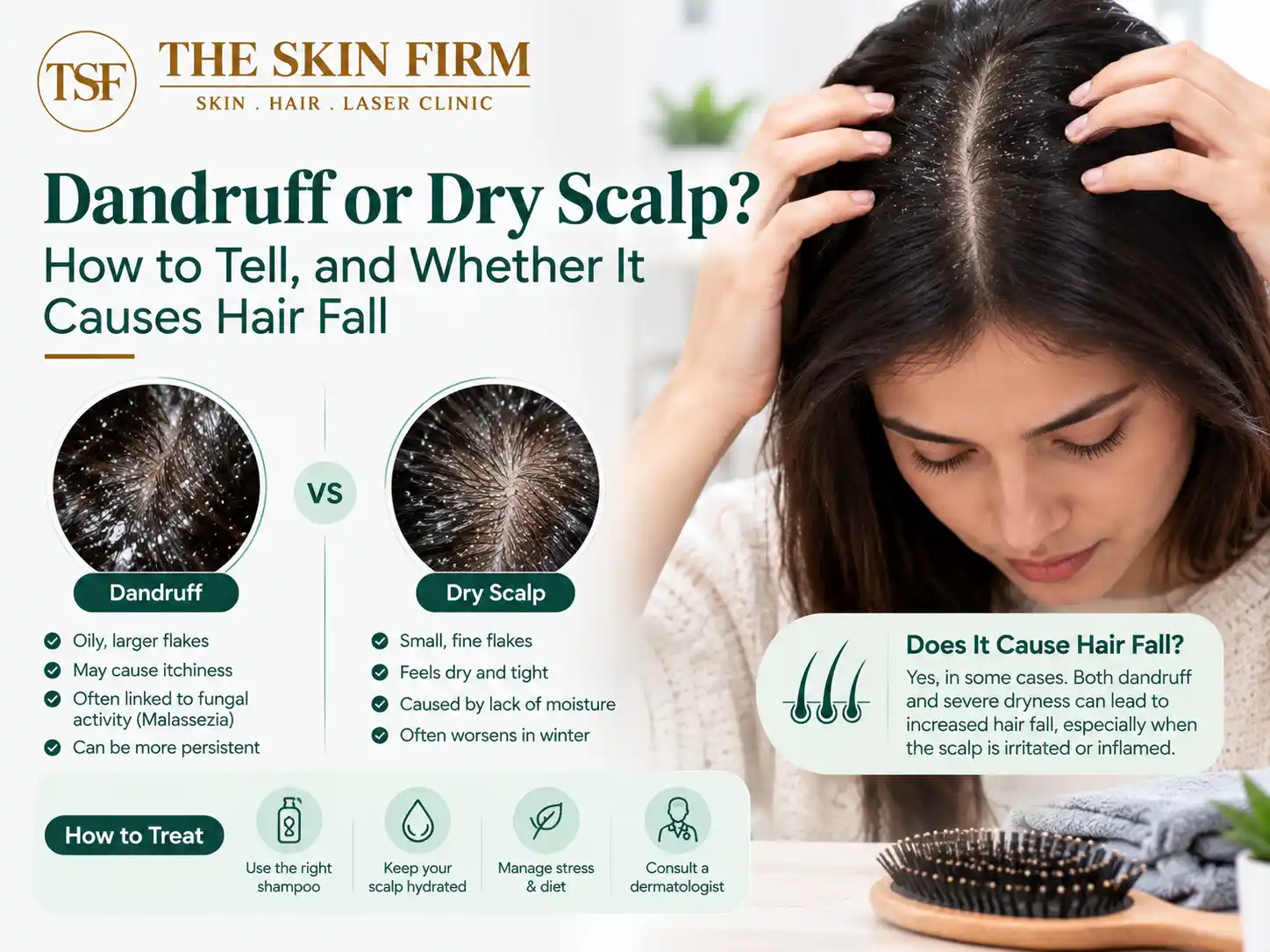
Dandruff produces oily, yellowish or white flakes and an itchy scalp, and it's linked to a yeast called Malassezia. A dry scalp produces small, dry, white flakes and feels tight, usually with dry skin elsewhere. Dandruff responds to medicated anti-dandruff shampoos. A dry scalp needs gentler washing and moisture. Dandruff doesn't directly cause baldness, but heavy itching and scalp inflammation can make hair fall worse.
Flakes on your shoulders are one of the most common scalp complaints, and they tend to get worse in Pune's dry winter months. People often treat every flaky scalp the same way, with more oil or a stronger shampoo, and are surprised when it gets worse. This guide explains how to tell dandruff from a dry scalp, when flaking is actually seborrhoeic dermatitis or something else, and how to treat each one. If your main worry is hair fall, see our page on hair loss treatment in Pune.
What causes dandruff?
Dandruff is a mild form of a condition called seborrhoeic dermatitis. Three things combine to cause it:
- 1. Oil (sebum) on the scalp
- 2. Malassezia, a yeast that lives on everyone's scalp and feeds on that oil
- 3. Individual sensitivity. In some people, the by-products of the yeast irritate the scalp and speed up skin shedding
The result is visible flakes and itching. That's why dandruff isn't caused by poor hygiene, although infrequent washing lets flakes build up and makes them more visible. Dandruff often worsens with stress, lack of sleep, cold dry weather and infrequent hair washing.
What causes a dry scalp?
A dry scalp is simply dry skin on the head. It happens when the scalp loses moisture faster than it can replace it. Common causes include:
- Cold, dry winter air and low humidity
- Very hot showers
- Washing with harsh shampoos too often
- Hair dyes and bleaching
- A generally dry skin type or conditions such as eczema
Dandruff vs dry scalp: how to tell
- Flakes: Dandruff: Larger, oily or waxy, white to yellowish; Dry scalp: Small, fine, dry and white
- Scalp feel: Dandruff: Oily, itchy; Dry scalp: Tight, itchy, sometimes rough
- Redness: Dandruff: Sometimes, especially along the hairline; Dry scalp: Usually none
- Other areas: Dandruff: May affect eyebrows, sides of nose, behind ears, beard; Dry scalp: Dry skin on face, arms and legs
- Season: Dandruff: Can occur year-round, often worse in winter; Dry scalp: Mostly winter
- What helps: Dandruff: Medicated anti-dandruff shampoo; Dry scalp: Gentle shampoo, less hot water, scalp moisturising
It's possible to have both: a dry scalp in winter along with mild dandruff. In that case, a medicated shampoo used two or three times a week, with a gentle conditioner on the lengths, often works well.
When flaking is seborrhoeic dermatitis
Seborrhoeic dermatitis is a more inflamed form of dandruff. Signs include:
- Red, greasy patches with yellowish scales on the scalp
- Flaking and redness on the eyebrows, sides of the nose, behind the ears or in the beard
- Itchy, red patches on the chest
- Flares with stress, illness or winter
It's a long-term condition that comes and goes. It can be well controlled with treatment, though it often needs ongoing maintenance.
Other causes of a flaky scalp
Some conditions look like dandruff but need different treatment. A doctor will check for:
- Scalp psoriasis: thick, well-defined, silvery-white plaques that often extend beyond the hairline onto the forehead or behind the ears
- Contact dermatitis: itching, redness and flaking after hair dye (especially dyes containing PPD), new shampoos or hair products
- Fungal infection of the scalp (tinea capitis): scaly patches with broken hairs or bald areas, more common in children
- Product build-up: dry shampoo, gels and sprays left on the scalp can look like flakes
- Head lice: eggs (nits) stuck to the hair shaft can be mistaken for dandruff
Does dandruff cause hair fall?
Dandruff doesn't directly cause baldness, and it doesn't damage hair follicles in the way pattern hair loss does. However, there are a few links:
- Scratching an itchy scalp can break hairs and pull out loose ones
- Inflammation from seborrhoeic dermatitis may make hair shedding worse, and controlling it often helps the scalp feel and look healthier
- They often appear together. Many people with pattern hair loss or telogen effluvium also have dandruff, so it's easy to blame the flakes for hair fall that has another cause
If you're losing a lot of hair, treat the dandruff, but also get your hair fall checked. Our guide to hair fall solutions for every hair type covers the common causes.
Can dandruff cause pimples?
It can contribute. The same yeast (Malassezia) and the oily scalp can trigger small bumps along the hairline and forehead, sometimes fungal acne rather than true acne. Flakes and hair products falling onto the face can also clog pores. If you get forehead breakouts and dandruff together, treating the scalp often helps the skin too. Our post on fungal acne vs regular acne explains the difference.
Anti-dandruff shampoo ingredients that work
Medicated shampoos are the main treatment for dandruff. The active ingredient matters more than the brand.
- Ketoconazole: How it helps: Antifungal; reduces Malassezia; Notes: Widely used for dandruff and seborrhoeic dermatitis
- Zinc pyrithione: How it helps: Antifungal and antibacterial; Notes: Good for mild dandruff and maintenance
- Selenium sulfide: How it helps: Slows skin shedding; antifungal; Notes: Can discolour light or chemically treated hair
- Ciclopirox: How it helps: Antifungal; Notes: Often prescribed for stubborn cases
- Salicylic acid: How it helps: Loosens and lifts flakes; Notes: Can dry the scalp if overused
- Coal tar: How it helps: Slows skin cell turnover; Notes: Strong smell; mainly for psoriasis-type scaling
How to use medicated shampoo correctly
- 1. Wet your hair and apply the shampoo mainly to the scalp, not the lengths
- 2. Massage gently and leave it on for 3–5 minutes before rinsing. This contact time is where most people go wrong
- 3. Use it two or three times a week at first, or as your doctor advises
- 4. Once flakes are under control, use it once a week to prevent them coming back
- 5. Use a mild shampoo and conditioner on other days if you wash more often
If one active stops working well, alternating between two different ones can help. If a shampoo burns or makes your scalp red, stop and ask a doctor.
Should you oil your hair if you have dandruff?
Many Indian families oil their hair regularly, and it can help dry, frizzy lengths. But oil left on a dandruff-prone scalp can feed Malassezia and make flakes and itching worse. If you have dandruff:
- Apply oil to the lengths rather than the scalp
- If you oil the scalp, wash it out within a few hours, not overnight
- Avoid oiling an inflamed, red or itchy scalp
For a purely dry scalp, a light scalp oil or serum before washing can help, as long as it's washed out.
Do home remedies work?
Popular remedies include lemon juice, curd, neem, apple cider vinegar, aloe vera and tea tree oil. Evidence for most of them is limited. A few points:
- Lemon and undiluted vinegar are acidic and can irritate or burn an inflamed scalp
- Tea tree oil has some evidence for mild dandruff, but must be diluted and can cause allergic reactions
- Aloe vera may soothe an itchy scalp but doesn't control the yeast
A medicated shampoo used correctly is usually more effective and predictable than kitchen remedies.
Dandruff in winter
Dandruff often flares in winter because dry air, hot showers and less frequent washing all disturb the scalp. Simple winter changes help:
- Wash with lukewarm, not hot, water
- Don't go too long between washes; flakes build up
- Keep your medicated shampoo routine going rather than stopping when the weather changes
- Dry your hair fully before tying it or wearing a cap or helmet
A weekly scalp routine for dandruff-prone hair
- Wash day 1: Medicated shampoo on the scalp, leave 3–5 minutes, rinse. Conditioner on lengths only
- Wash day 2: Mild shampoo. If you oil, apply to lengths only, 1–2 hours before washing
- Wash day 3: Medicated shampoo again (or alternate active ingredient)
- Every day: Comb gently, avoid scratching, dry hair fully before tying it up or wearing a helmet
Wash pillowcases, caps and helmet liners every week, and clean combs and brushes regularly. Styling gels, waxes and dry shampoo should be washed out the same day.
Dandruff in the beard, eyebrows and face
Seborrhoeic dermatitis doesn't stop at the hairline. Many men notice flakes and redness in the beard, and both men and women can get flaking in the eyebrows, the creases beside the nose and behind the ears. The same antifungal ingredients help, but facial skin is more delicate. Doctors often suggest using an anti-dandruff shampoo as a short-contact face or beard wash, or prescribe a gentle cream. Avoid using strong scalp treatments on the face without advice.
Dandruff in children and teenagers
Babies can get thick, yellow, greasy scales on the scalp called cradle cap, a form of seborrhoeic dermatitis that usually settles on its own. Dandruff is uncommon in younger children, so a scaly scalp in a child, especially with hair loss or broken hairs, should be checked for a fungal infection. In teenagers, rising oil production often brings the first episodes of dandruff, which respond to the same shampoos adults use.
How a doctor treats stubborn dandruff
If over-the-counter shampoos haven't helped after 4–6 weeks, a doctor can:
- Confirm whether it's dandruff, seborrhoeic dermatitis, psoriasis, an allergy or a fungal infection
- Prescribe stronger antifungal shampoos or scalp lotions
- Prescribe a short course of an anti-inflammatory scalp lotion to calm severe itching and redness
- Check for and treat any associated hair fall
- Advise on a maintenance plan so flare-ups are less frequent
You can book a consultation at The Skin Firm, a skin, hair and laser clinic at NIBM Road, Pune, if your scalp isn't settling.
When to see a doctor
- Flaking or itching doesn't improve after 4–6 weeks of anti-dandruff shampoo
- The scalp is red, swollen, painful, oozing or crusted
- You have thick plaques, or patches beyond the hairline
- Flaking comes with patchy hair loss or broken hairs
- Your child has a scaly scalp with bald patches
- Itching started after hair dye or a new product
References
- How to treat dandruff — American Academy of Dermatology
- Seborrhoeic dermatitis — DermNet
- Dandruff — NHS
- Seborrheic dermatitis and dandruff: a comprehensive review — Journal of Clinical and Investigative Dermatology, 2015
This article is for general information and isn't a substitute for a medical consultation. Editorial note: drafted with AI assistance and medically reviewed before publication.