 Add as a preferred source on Google
Written by The Skin Firm clinical content team · Medically reviewed by Dr. Monica C., MD (Dermatology, Venereology & Leprosy) · Reviewed on 16 October 2026
Quick answer
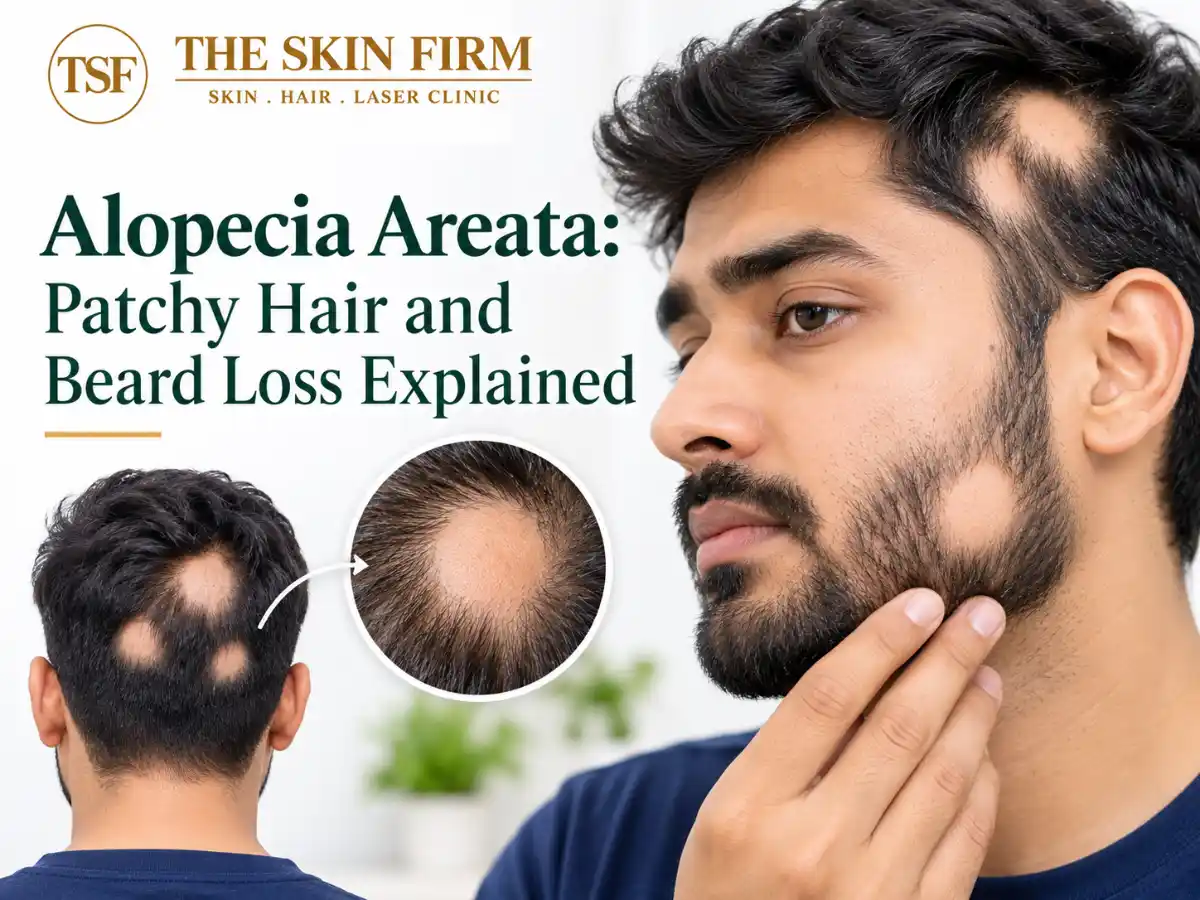
Alopecia areata is an autoimmune condition in which the immune system attacks hair follicles, causing smooth, round bald patches on the scalp, beard, eyebrows or elsewhere. The follicles aren't destroyed, so hair can grow back, and many small patches regrow within a year, with or without treatment. A dermatologist can speed regrowth with treatments such as steroid injections into the patches. There's no permanent cure, and new patches can appear later.
Finding a sudden coin-sized bald spot while combing, or a patch in your beard while shaving, is alarming. Alopecia areata is one of the most common causes of patchy hair loss, and it affects people of all ages, including children. This guide explains what it is, how it's diagnosed, the treatments a dermatologist may use and what you can realistically expect. For other types of hair loss, see our page on hair loss treatment in Pune.
What is alopecia areata?
In alopecia areata, the body's immune system mistakenly targets the hair follicles. The follicles are pushed into a resting state and stop producing visible hair. Unlike scarring hair loss, the follicles remain alive under the skin, which is why regrowth is possible even after long periods.
It isn't contagious, it isn't caused by poor hair care, and it isn't the same as general hair thinning or pattern baldness.
Signs and symptoms
- One or more round or oval smooth bald patches, often about the size of a coin
- Normal-looking skin in the patch, without scaling or scarring. Occasionally a little redness, tingling or itching before hair falls
- Short broken hairs at the edges of a patch that taper towards the scalp, called "exclamation mark hairs"
- Patches in the beard, eyebrows or eyelashes
- Small pits or ridges in the fingernails in some people
- Regrowing hair that may be fine and white at first before regaining its colour
Types of alopecia areata
- Patchy: What happens: One or a few round patches; Outlook: Most common; many regrow within a year
- Ophiasis: What happens: A band of hair loss along the sides and back of the scalp; Outlook: Tends to be more persistent
- Beard (alopecia barbae): What happens: Patches in the beard area; Outlook: Often regrows; can recur
- Alopecia totalis: What happens: Loss of all scalp hair; Outlook: Less common; harder to treat
- Alopecia universalis: What happens: Loss of all scalp and body hair; Outlook: Rare; harder to treat
- Diffuse: What happens: Sudden thinning over the scalp rather than patches; Outlook: Can be confused with other hair fall
What causes it?
The exact trigger isn't fully understood, but several factors are linked:
- Genetics. It's more common if a family member has it
- Other autoimmune conditions, such as thyroid disease and vitiligo
- Allergic conditions, such as eczema, asthma and hay fever
- Stress or illness, which may trigger an episode in people who are already prone, though alopecia areata can start without any obvious stress
Stress alone doesn't cause alopecia areata in everyone, and worrying about having caused it isn't useful. It's mainly a matter of how your immune system behaves.
How it's diagnosed
A dermatologist can usually diagnose alopecia areata by examining the patches. Trichoscopy, a magnified look at the scalp, shows typical features such as yellow dots, black dots and exclamation mark hairs. Your doctor may also:
- Do a gentle pull test at the edges of patches to see if they're still active
- Look at your nails and eyebrows
- Suggest blood tests for thyroid function, vitamin D, blood count or others, based on your history
- Rarely, take a small scalp biopsy when the diagnosis is uncertain
It's important to rule out look-alikes, such as fungal infection of the scalp (which usually has scaling and broken hairs), traction alopecia from tight hairstyles, trichotillomania (hair pulling), and scarring types of hair loss.
Will my hair grow back?
Often, yes. Many people with a few small patches see regrowth within 6 to 12 months, even without treatment. However, the course is unpredictable:
- New patches can appear while others are regrowing
- Many people, and in some studies most, have more than one episode during their life
- Extensive loss, ophiasis, loss that starts in childhood and long-standing patches are less likely to regrow fully
Treatment can speed up regrowth and help control active disease, but it doesn't prevent future episodes. Any claim of a guaranteed or permanent cure isn't supported by evidence.
Treatment options a dermatologist may use
Treatment depends on your age, how many patches you have, how long you've had them and where they are.
Steroid injections into the patches. For adults with a few patches on the scalp, beard or eyebrows, small injections of a corticosteroid into the patches are a common first choice. They're usually repeated every 4–6 weeks. Regrowth often starts within a few weeks to a couple of months. Possible side effects include temporary dimpling of the skin at injection sites and discomfort.
Topical steroids. Strong steroid creams, lotions or foams may be used, especially for children or people who don't want injections.
Minoxidil. Sometimes used alongside other treatments to support regrowth. It doesn't control the immune process on its own.
Topical immunotherapy. For extensive patches, some specialists use a chemical applied to the scalp to create a mild allergic reaction that redirects the immune response. It requires regular clinic visits.
Oral medicines. For severe or rapidly spreading alopecia areata, doctors may consider short courses of oral steroids or other immune-modulating medicines. Newer oral medicines called JAK inhibitors are approved in some countries for severe alopecia areata. All of these need careful medical supervision because of possible side effects.
Your dermatologist will discuss benefits, risks, the number of visits and realistic expectations for each option.
Alopecia areata in the beard
Beard patches are common in men and are often noticed while shaving or trimming. They're treated with the same principles: steroid injections or topical treatments, guided by a dermatologist. While waiting for regrowth, some men keep the beard shorter so patches are less visible, or choose a clean-shaven look. Avoid harsh rubbing or home remedies on the patches.
Laser hair removal and laser beard shaping don't treat beard alopecia. If you're thinking about beard grooming procedures, discuss your history of alopecia areata with your doctor first.
Alopecia areata in children
Children can develop alopecia areata too. Treatment is usually gentler, often with topical treatments rather than injections. Because school and appearance can be stressful, talk openly with your child, let teachers know if needed, and see a paediatric or skin specialist. Check that a scaly patch in a child isn't a fungal infection, which needs different treatment.
Alopecia areata vs other types of hair loss
- Alopecia areata: Pattern: Smooth round patches; Scalp: Normal, no scaling; Typical clue: Sudden patch; exclamation mark hairs at the edge
- Telogen effluvium: Pattern: Diffuse shedding all over; Scalp: Normal; Typical clue: 2–3 months after illness, childbirth or stress
- Pattern hair loss: Pattern: Receding temples, crown or widening parting; Scalp: Normal; Typical clue: Gradual over years; family history
- Fungal infection (tinea capitis): Pattern: Scaly patches with broken hairs; Scalp: Scaly, sometimes inflamed; Typical clue: More common in children
- Traction alopecia: Pattern: Thinning along the hairline or parting; Scalp: May have bumps; Typical clue: Tight braids, buns or ponytails
- Trichotillomania: Pattern: Irregular patches with broken hairs of different lengths; Scalp: Normal; Typical clue: Urge to pull hair, often unnoticed
If you also notice heavy shedding after an illness, our post on hair fall after dengue, typhoid or fever explains that pattern.
What to expect at your first appointment
- 1. Questions about when the patches started, whether they're growing, family history and other health conditions
- 2. Examination of the scalp, beard, eyebrows, eyelashes and nails
- 3. Trichoscopy to look closely at the patches
- 4. A discussion of whether blood tests are useful for you
- 5. A treatment plan, including how often you'd need to return and what regrowth might look like
Taking clear photos of the patches every few weeks helps you and your doctor see whether they're growing or regrowing.
Caring for your hair and scalp during an episode
- Wash and condition as usual with mild products; gentle care won't make patches worse
- Avoid tight hairstyles, harsh chemical treatments and heat styling while patches are active
- Protect bald patches from the sun with a cap or sunscreen, as the skin there burns easily
- Don't rub oils, onion juice or other home preparations into the patches, which may irritate the skin
- Be patient with regrowth: new hair grows about 1 cm a month and may start out fine and pale
Myths about alopecia areata
"Onion juice or garlic will cure it." There's very limited evidence for these, and they can irritate the scalp. They aren't substitutes for medical treatment.
"It's caused by shampoo or hair oil." Hair products don't cause alopecia areata.
"It will spread to my whole head." Most people have patchy disease that doesn't progress to total hair loss.
"It's contagious." It can't be passed from person to person.
"Shaving the area makes hair grow back faster." It doesn't affect regrowth.
Coping with patchy hair loss
Alopecia areata doesn't affect general health, but it can affect confidence and wellbeing. Things that help many people:
- Changing a parting or hairstyle to cover patches
- Using hair fibres, scarves, caps or, for extensive loss, a wig
- Filling in eyebrows with makeup or brow products
- Talking to family, friends or a counsellor if it's affecting your mood
- Remembering that regrowth is common and treatment can help
When to see a doctor
- You notice one or more bald patches
- Patches are spreading or new ones keep appearing
- You lose eyebrow, eyelash or beard hair
- There's scaling, redness, pain or pus in the patches
- A child develops patchy hair loss
You can book a consultation at The Skin Firm, a skin, hair and laser clinic at NIBM Road, Pune, to have patchy hair loss examined. For general hair fall, see our guide to hair loss treatment in Undri and NIBM.
References
- Alopecia areata overview — American Academy of Dermatology
- Alopecia areata — DermNet
- Alopecia areata: symptoms, causes, treatment and regrowth — Cleveland Clinic
This article is for general information and isn't a substitute for a medical consultation. Editorial note: drafted with AI assistance and medically reviewed before publication.