 Add as a preferred source on Google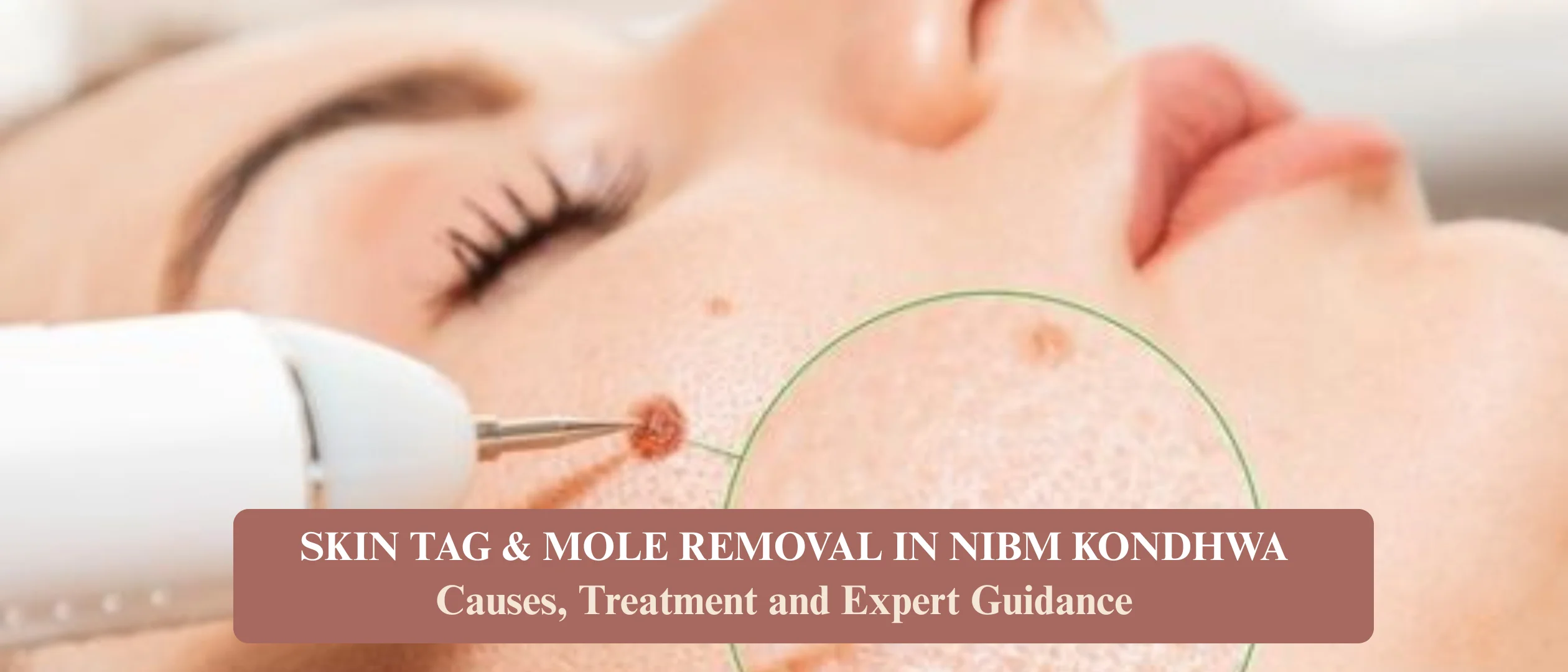
Most patients who come to us at The Skin Firm in NIBM Kondhwa did not book the appointment the moment they noticed the skin tag. They waited. Six months, sometimes two years. Life got in the way, or they assumed it would be a drawn-out process involving multiple visits and a long recovery.
It is almost never that. The majority of procedures are done in a single sitting, and most people are back to their day within the hour.
Skin Tags
Clinically, they are called acrochordons. In practical terms, they are small soft growths that hang off the skin, usually in spots where the body creates friction against itself. The neck tends to be the most common place. After that, the underarms, the eyelid area, beneath the breasts, and the inner thighs.
They are not harmful. Not a symptom of something worse. Not contagious. For some people, knowing that is enough and they choose to live with them. For others, a tag that keeps snagging on a collar or a necklace, or one that sits somewhere difficult to ignore, becomes reason enough to do something about it.
Both decisions are valid. We see patients across the full range.
Moles
The process with moles is a little different, and it should be. Before anything else, we want to look at it properly.
Moles develop when melanocytes, the pigment-producing cells in the skin, gather in one place rather than spreading out. A lot of people are born with them. Others develop them gradually through childhood and early adulthood. For the most part they sit there, unchanged, for decades.
The ones we pay closer attention to are the ones that have started behaving differently. A border that is no longer clean. A colour that has become uneven. One that itches, or bleeds without any real cause. If a mole is doing any of these things, we look at it carefully before deciding on next steps. That step is not skipped here, regardless of how simple the removal itself might seem.
So What Actually Causes Skin Tags?
Honestly, there is no single clean answer. Skin tags tend to develop because of several things happening together rather than one clear-cut reason.
Friction is at the top of the list. The spots where skin folds against itself repeatedly, year after year, are exactly where tags tend to cluster. It is largely physical.
Blood sugar plays a bigger role than most people realise. Patients managing Type 2 diabetes or prediabetes tend to develop skin tags more often and sometimes in greater numbers. Pregnancy can bring them on suddenly too, which comes down to the hormonal changes happening throughout that period.
Body weight factors in as well. More skin folds simply means more opportunity for friction to occur on a consistent basis.
Family history is worth considering. If a parent developed skin tags, there is a reasonable chance you will too, even if everything else about your lifestyle is quite different.
Age tends to be when it all comes together. Most people start noticing skin tags in their 40s and 50s, though younger adults are certainly not immune, especially when other factors are present.
None of this points to poor health. These are ordinary skin occurrences that happen to be straightforward to address.
And What About Moles?
Most moles trace back to a combination of genetics and sun exposure during the earlier years of life. The average adult is carrying somewhere between 10 and 40 of them, the vast majority of which will never cause any trouble.
People who have spent a lot of time outdoors, particularly without consistent sun protection, tend to develop more moles across their lifetime. That does not automatically mean something is wrong, but it does mean there is more to keep an eye on.
Hormones can make existing moles look a little darker or more prominent, which tends to happen during puberty and pregnancy. On its own, that is usually not concerning. What matters is whether the change is gradual or sudden, and whether anything else about the mole seems different.
Types of Treatments
We do not take a fixed approach and apply it to everyone. The method depends on the growth itself, where it is located, how deep it sits, and how your skin responds generally.
Radiofrequency Cauterization (RF) is what we use most often for skin tags. It targets the growth with a good level of precision while leaving the surrounding tissue largely alone. This is particularly relevant for tags near the face and neck, where a less careful method would leave a visible mark.
Electrocautery uses a controlled electrical current to remove the tissue. It is a well-established technique and handles a range of sizes without much fuss.
Cryotherapy involves applying liquid nitrogen to freeze the growth. It is non-invasive and the downtime is minimal. Works reliably for flatter, smaller lesions.
Surgical Excision is reserved for moles that sit deeper than the other methods can adequately reach. Done under local anaesthesia, it takes roughly 20 to 30 minutes. When there is clinical reason to examine the tissue further, we send it for histopathological analysis.
Laser Removal suits flat, pigmented moles and surface-level skin tags well. No incisions, no sutures, and recovery is generally uncomplicated.
Aftercare
A small scab will form. This is expected and it is actually a positive sign. The skin is healing beneath it, and the scab is protecting that process. Picking at it before it is ready pulls away the layer forming underneath and significantly increases the chance of a lasting mark.
Sun protection is the other thing we stress. Freshly treated skin is much more reactive to UV exposure than usual, and pigmentation changes are considerably more likely if the area is left unprotected. Consistent sunscreen use for at least four to six weeks is not a suggestion, it is a genuine part of getting a good result.
Active skincare ingredients like retinoids, exfoliating acids and vitamin C should stay away from the treated area for the first couple of weeks. Gentle moisturiser and whatever was prescribed is enough during that period.
Most patients are back to their routine the same day. There is no rest requirement.
The Skin Firm is in NIBM Kondhwa, Pune. We regularly see patients from Undri, Katraj, Wanowrie, and Mohammadwadi. A number of them have come specifically because they wanted their skin actually assessed before anyone made a recommendation, which is just how we work here.
Pricing is discussed clearly before anything proceeds. There is no figure that changes by the time you reach the billing counter.
Booking a Consultation
If the decision has been sitting on the back burner for a while, coming in for an assessment is a sensible starting point. There is no obligation to proceed on the day. The consultation exists to give you a clear picture of what you are dealing with and what the realistic options are.
The Skin Firm Clinic | NIBM Kondhwa, Pune Book via call or WhatsApp